About Magnolia macrophylla Michx.
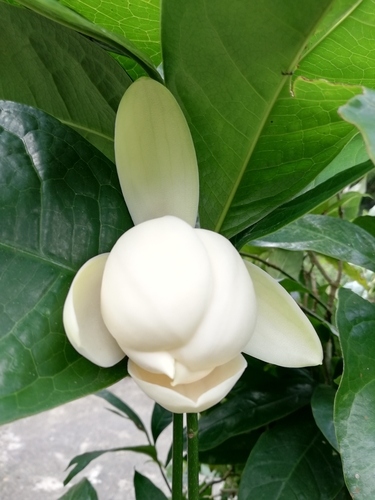
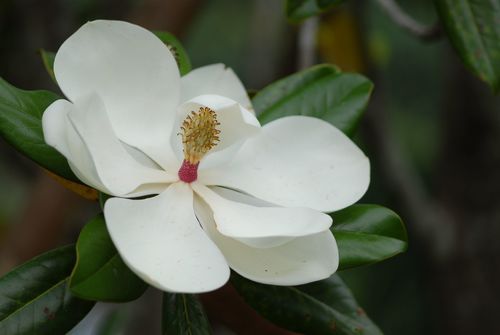
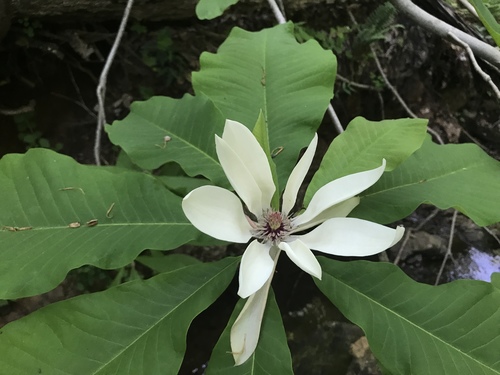
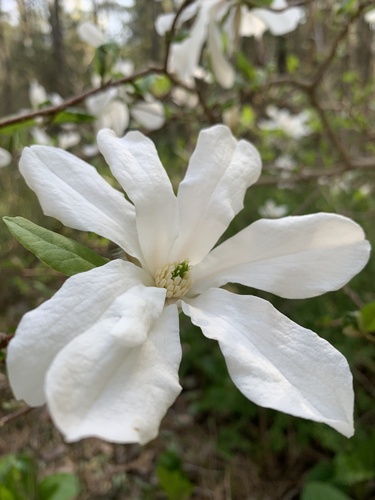
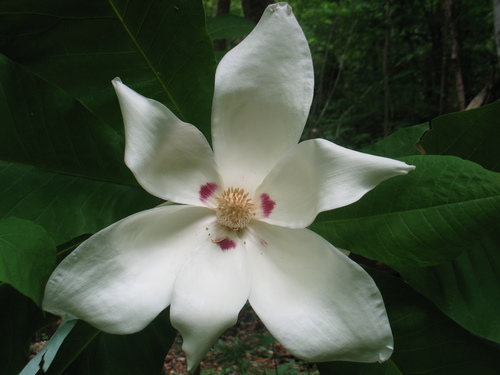
Magnolia macrophylla Michx., commonly known as bigleaf magnolia, is a medium-sized understory tree that typically grows 15–20 m (49–66 ft) tall. The Eastern Native Tree Society has documented some individuals over 27 m tall, with a circumference exceeding 100 cm. This species is set apart from other magnolias by its very large leaves, which are usually 24–60 cm (9.4–23.6 in) long and 11–26 cm (4.3–10.2 in) wide, rarely reaching up to 100 cm (39 in) in length and 32 cm (13 in) in width. Each leaf has a stout 5.5–15 cm (2.2–5.9 in) petiole, and the tree's branches often bend under the weight of this heavy foliage. Its flowers typically have nine tepals arranged in three whorls of three, though sometimes only six tepals form; the larger tepals have a purple spot at their base. The tepals are generally 14.5–20.5 cm (5.7–8.1 in) long and 5–14 cm (2.0–5.5 in) wide. Like all magnolias, bigleaf magnolia is pollinated by beetles. Its fruit is a cone-like cluster of achenes that measures 5.5–8 cm (2.2–3.1 in) long. When mature, each seed is covered with an orange aril and hangs down from the fruit cone on silk-like threads, making the seeds easily accessible to passing birds. Bigleaf magnolia grows naturally in rich mesic woods. Disturbance that allows more light to reach the ground helps this species establish successfully. While it grows relatively faster when exposed to more light, other understory and canopy trees and their seedlings usually outgrow and outcompete it. This works well for bigleaf magnolia, as it tolerates low light levels; it does not require full sun to survive once established, though it cannot tolerate full shade. Natural regeneration of this species is quite limited. This is due to the scarcity of mature, seed-bearing plants, most populations are made up of widely scattered individuals, the species produces poor seed sets likely from the limiting factors already mentioned, and it has low seed viability. This poor seed set and low seed viability is a trait it shares with its cousin Fraser magnolia, a frequent wild associate of bigleaf magnolia in Appalachia. In the southeastern United States, particularly in Alabama and surrounding areas, Magnolia macrophylla is sometimes called cowcumber magnolia; this name distinguishes it from the smaller-leaved cucumber-tree magnolia, M. acuminata. In cultivation, bigleaf magnolia is often short-lived unless its fairly demanding growing requirements are met. It prefers loose, undisturbed rich mesic soil, or mulch and compost substitutes, in full sun or part shade, with moist, well-drained soil and a low pH. It will usually grow well at sites that closely mimic its natural habitat, and where it is sheltered from strong wind, which can tear its large foliage. It can be grown farther north than its natural southerly range suggests, but requires watering during extended dry periods. It is generally free of cultivation problems.