About Maevia inclemens (Walckenaer, 1837)
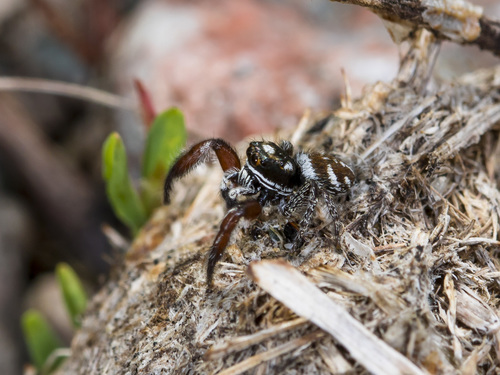
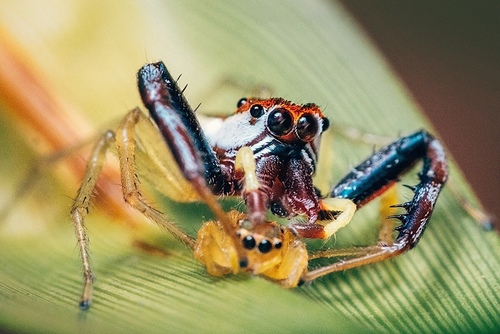
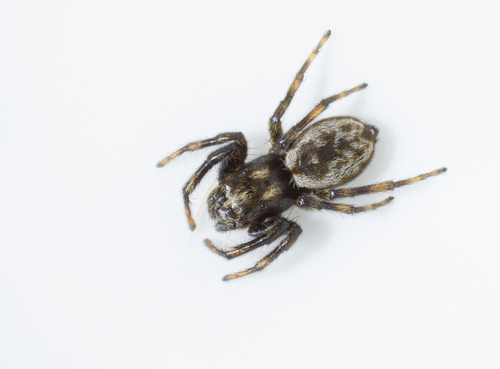
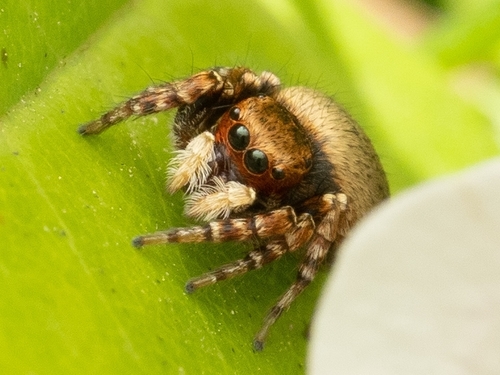
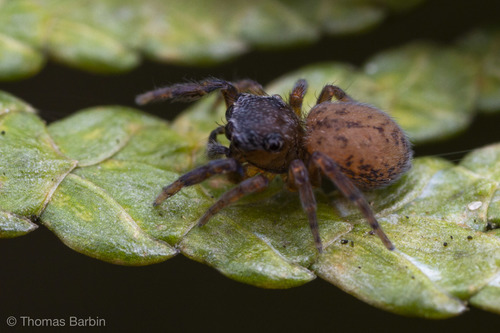
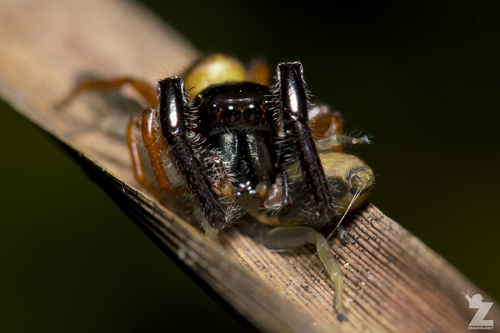
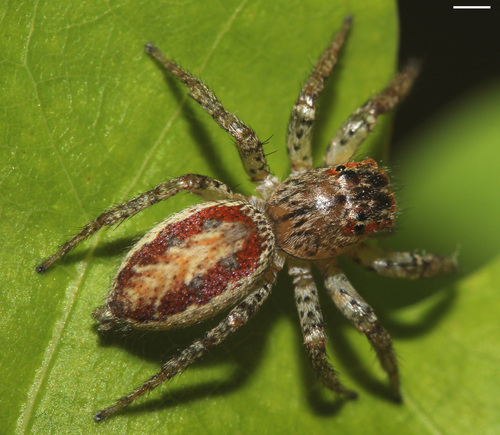
Maevia inclemens is a species of jumping spider first described by Walckenaer in 1837. As with all spiders, which are a group of chelicerate arthropods, M. inclemens has its body segments fused into just two tagmata: the cephalothorax and abdomen, connected by a small cylindrical pedicel that lets the abdomen move while spinning silk. Its abdomen bears modified appendages called spinnerets that extrude silk from up to six types of abdominal silk glands. Like most jumping spiders, M. inclemens does not build webs to catch prey, but uses silk for activities including molting and egg-laying. Like all spiders, M. inclemens lacks extensor muscles in its limbs, and instead extends limbs by increasing internal blood pressure. Jumping spiders generally have large forelegs and short, powerful hind legs, and can leap several times their own body length by powerfully extending their third or fourth leg pairs, reaching up to 200 millimetres (7.9 in) with forelimbs extended to grasp prey. When walking, spiders maintain balance by moving legs 1 and 3 on one side and legs 2 and 4 on the other, while the remaining four legs stay on the surface; they increase stride frequency to run faster. Like all spiders, M. inclemens has only one pair of appendages in front of the mouth, modified into fangs that inject venom into prey. Behind the mouth is a pair of pedipalps (often shortened to "palps"); in male spiders, these are quite large and used for courtship display and mating. Spiders groom themselves regularly, grooming more often when wet or dirty. They moisten their fangs, draw each leg through the fangs one at a time, and comb legs with their fangs and palps. The first and fourth pairs of legs are then used to groom other body areas; the only part spiders cannot reach is the dorsal surface of the carapace. The body of M. inclemens is only sparsely covered with hairs and scales. Female M. inclemens measure 6.5 to 8.0 millimetres (0.26 to 0.31 in) in total body length. Females have a light brown carapace, pale unmarked legs, and a chalky or rusty-colored abdomen top, with a black band along each side that is often thinly covered with orange scales. Females sometimes have a series of V-shaped chevron markings along the middle of the abdomen, and a prominent white stripe below the foremost eyes. Spines are present on the first and second pairs of female legs, and females never have hair tufts on their bodies. Male M. inclemens are 4.75 to 6.50 millimetres (0.187 to 0.256 in) long. Males have a light to dark brown carapace with a black line along the edge, usually a pair of large lighter-colored areas between the last pair of eyes halfway down the back of the carapace, and black coloring surrounding the eyes. Uniquely for this species, males occur in two distinct forms, a very rare phenomenon in zoology. The "tufted" male morph has an entirely black body, black pedipalps, white legs, and three tufts of bristles on the front portion of the cephalothorax. The "gray" male morph has a black and white striped body, a prominent white stripe on the foremost eyes, striped legs, bright orange pedipalps, and no tufts. Jumping spiders have a distinctive rectangular carapace; for female M. inclemens the carapace averages 2.30 millimetres (0.091 in) wide, while the average carapace width for males is 2.10 millimetres (0.083 in). The M. inclemens carapace is fairly high, with a height between 60% and 70% of its width. Maevia inclemens is distributed throughout the eastern and mid-western United States and south-eastern Canada, including Massachusetts, Connecticut, New York state, New Jersey, Pennsylvania, Maryland, West Virginia, Virginia, North Carolina, Florida, Alabama, Louisiana, Texas, Kansas, Kentucky, Indiana, Illinois, Michigan, Wisconsin, Quebec, Ontario, and Manitoba. A 1981 study investigated spider abundance on one mature and three recently clear-cut sites in the southern Appalachian Mountains near Highlands, North Carolina, where all hunting spiders were collected from plants and webs above ground. Clear-cutting caused a marked abundance decrease in nine species and a marked increase in four; M. inclemens and six other species showed no change in abundance. A small number of jumping spider species, including M. inclemens, can establish populations in man-made structures. Most often, these spiders are found on outbuildings or structures such as fences, rather than in permanently inhabited houses. Among adult male M. inclemens, each of the two male morphs makes up 50% of the population. Both morphs make the same number of courtship attempts, but use different courtship displays. Before searching for a mate, a male spider spins a small, flat web on a surface, ejaculates into it, then loads semen into syringe-like receptacles in both palps before beginning his search for a female. After spotting a female, the tufted morph raises himself as high as possible using his last three pairs of legs, claps with his foremost pair of legs, waves his palps up and down, and swings his abdomen from side to side, usually staying about 9 centimetres (3.5 in) from the female. In contrast, the gray morph crouches down, points his foremost two pairs of legs directly forward, crosses the leg tips to form a triangle-like shape, holds his orange-colored palps beneath his forward eyes, and glides back and forth in stationary or receding semi-circles in front of the female, staying 3 centimetres (1.2 in) away. Later in the courtship sequence, the movements of both morphs are identical. When receptive to mating, females respond similarly to both male types: they approach and settle, either extending the foremost pair of legs or tapping with them. After this initial female response, both male morphs typically end their initial display and begin leg-clapping and zig-zag dancing. When tufted males clap, females turn toward them and perform more tap displays toward tufted males than toward gray morphs. Females also more often respond to tufted morph clapping by settling, compared to their response to gray morph clapping. However, after females turn toward the males, gray males approach the female more often than tufted males do. Females often tip their abdomens from side to side during this process. Finally, the male mounts the female and copulates. After copulation, the male generally dismounts, and both spiders usually run away from each other. Sometimes, however, the male chases the female and attempts to copulate again. In one experiment, 12 out of 23 tufted males (52%) and 14 out of 26 gray males (54%) copulated with females after courtship. At the end of copulation, females attempted to capture and eat the males, but only one tufted and one gray male were killed in this experiment. Counts of offspring showed no difference in the number of spiderlings produced by matings with the two morphs. Gray males gained female attention more quickly when they were within 8 centimetres (3.1 in) of the female, while tufted males were quicker to gain attention when they were between 8 and 30 centimetres (3.1 and 11.8 in) away. The persistence of two distinct male morphs in M. inclemens may be an example of a mixed evolutionarily stable strategy, where both morphs are genetically determined by the morph of the male's father, and both are equally successful in their differing reproductive strategies.