About Maerua angolensis DC.
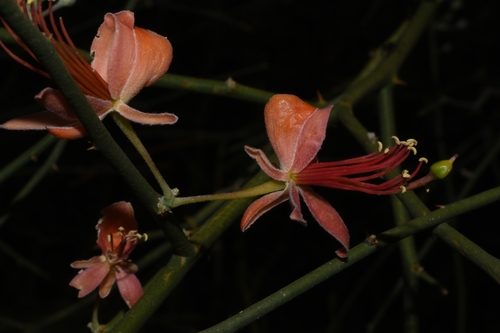
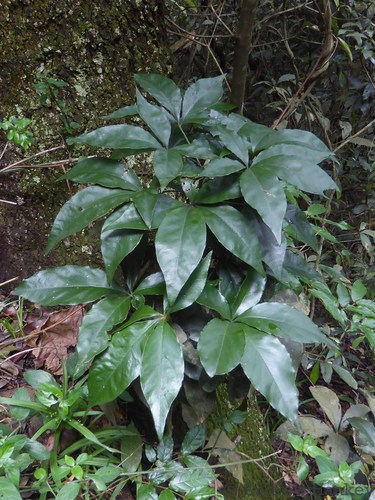
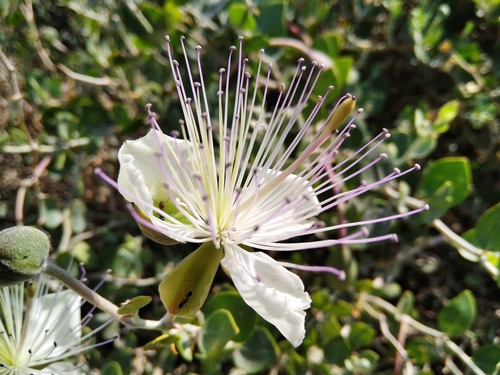
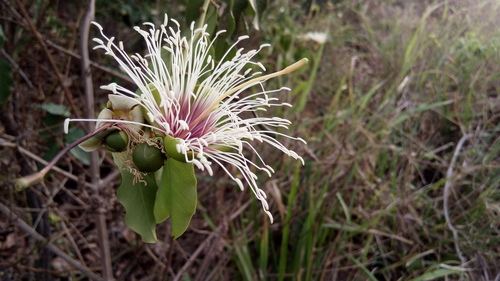
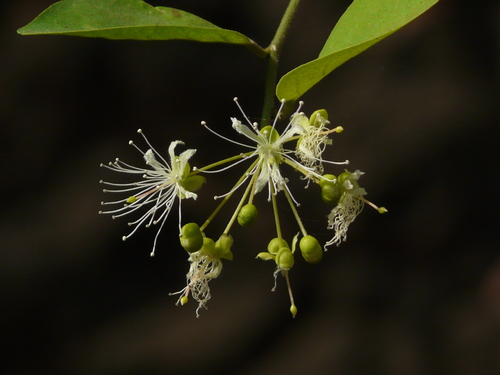
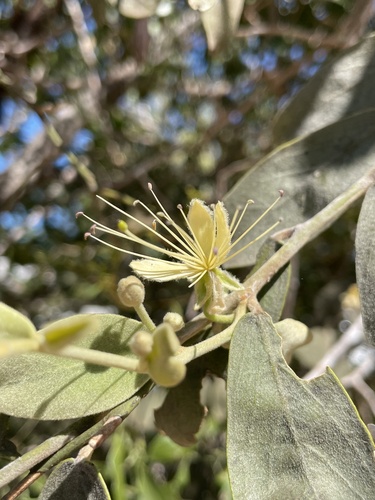
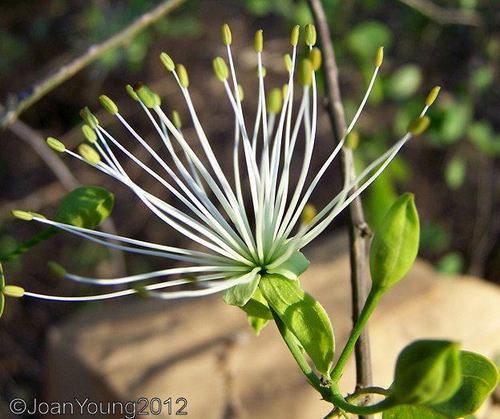
Maerua angolensis DC. is a tree species that grows with a rounded crown and smooth grey bark that flakes to expose yellowish-orange patches. Like most species in its family, its twigs and branches have prominent lenticels. Its leaves are soft, drooping, and alternate, with a broadly elliptic to ovate shape. They have rounded or notched, mucronate apexes with a terminal bristle, and petioles that are the same length as the leaf blades, becoming visibly thicker or inspissate at their ends. Leaf surfaces are often noticeably scratched from rubbing against the bristles of surrounding leaves. This species varies in pubescence, ranging from entirely glabrous to pubescent on stems and leaves. Its fragrant, pincushion-like flowers have no petals, and are produced in large quantities at the start of the rainy season. The flowers have around 50 numerous long filaments, which are initially pale yellow and darken as they age. When the flower opens, its four calyx segments curve backward, and the base of the calyx is fringed with hairs. The species produces a distinctive torulose silique fruit that resembles a string of beads, reaching roughly 150mm in length. A slender, taller subspecies growing in the Socotra archipelago, Somalia, Ethiopia and Yemen has been classified as Maerua angolensis subsp. socotrana (Schweinf. ex Balf. f.) Kers. M. angolensis is similar to Namibia’s M. schinzii Pax., which differs by having thicker, almost fleshy leaves and other relatively minor differences. The wood of M. angolensis is whitish-yellow, hard, dense, and fine-grained, and it tends to split into concentric layers along its annual rings. This species is distributed across Burkina Faso, Burundi, Cameroon, Chad, Eritrea, The Gambia, Ghana, Kenya, Mali, Mauritania, Niger, Nigeria, Rwanda, Senegal, Sudan, Tanzania, Togo, Uganda, and extends south into Angola, Botswana, Caprivi Strip, Eswatini, Malawi, Mozambique, Namibia, South Africa, Zambia and Zimbabwe. Its genus Maerua contains around 57 species, most native to tropical Africa, with a range that also extends into the Middle East and tropical Asia. The leaves of this plant have an unpleasant bitter taste, but African rural tribes use them as a food supplement during periods of famine, and also use them as a purgative. Powdered leaves are used as a fish poison, and to treat anorexia and asthenia. Bark extracts and pulped leaves are applied to promote wound healing. Leaf decoctions are given to children with amoebic dysentery or jaundice, and are also used to treat rheumatism, stomach-ache, epilepsy and diarrhoea. Bark decoctions are used to treat malaria and as an aphrodisiac. Game and livestock readily graze on the species’ foliage. Like other members of its family, this species is a host plant for butterflies of the family Pieridae. Instar larvae can fully defoliate a tree, but the tree readily regrows its leaves. Phytochemical analysis of the bark has found glycosides, terpenes, tannins, flavonoids, saponins, carbohydrates, proteins, alkaloids and other constituents. Additional studies indicate that the bark is non-toxic when used in anti-inflammatory doses, which supports the ethnomedical use of this plant to manage inflammation.