About Maculinea arion (Linnaeus, 1758)
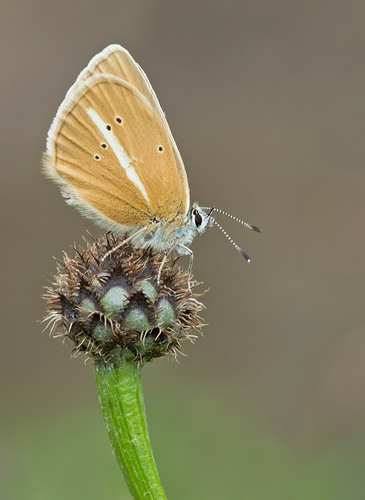
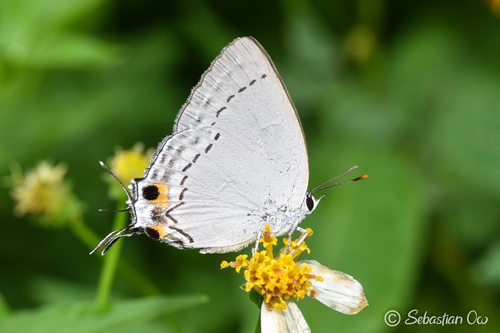
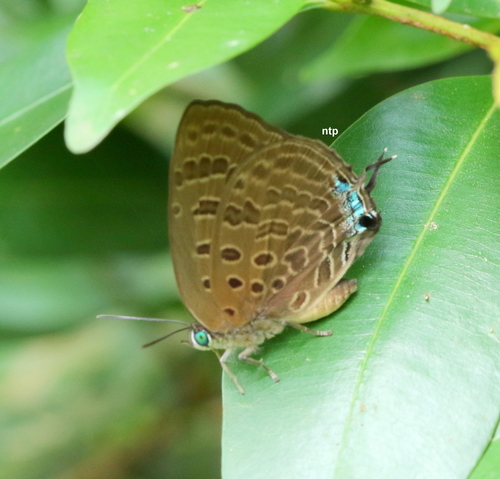
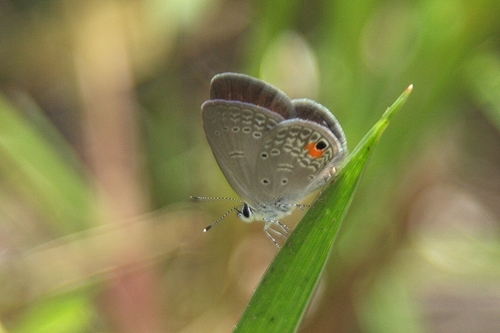
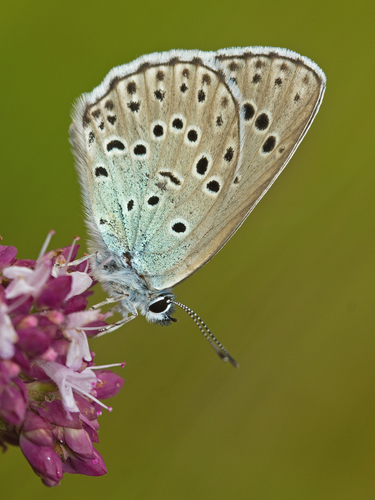
Maculinea arion, commonly known as the large blue butterfly, has caterpillars that grow to around half an inch (13 millimetres) in length. Caterpillars spend up to 9 months before undergoing metamorphosis into a chrysalis to become an adult butterfly. Large blue butterflies are among the largest members of the gossamer-winged butterfly family Lycaenidae, reaching a wingspan of up to 2 inches (51 millimetres), and adult individuals only live for a few weeks. The wings of the adult large blue butterfly are speckled with black dots. A description by Seitz notes that this species is larger than related forms such as arcas, and has a lighter, more shining blue on the upper wing surface, with a row of black spots crossing both wings; the spots are sometimes only absent on the hindwing of males. The species can be immediately recognized by the large number of ocelli on the underside of the wings, especially on the hindwing, and by the bright blue dusting at the base of the underside of the wings. Its range covers Europe and Anterior Asia, extending from Northern Europe, the Baltic provinces, and England south to the Mediterranean (including Corsica), and from Spain east to Armenia and South Siberia. Several aberrations of the species are recognized: ab. unicolor Hormuz. has an entirely blue upper wing surface, with all black spots absent except the discocellular spot; ab. Arthurus Melvill has no ocelli on the underside of the wings; ab. jasilkowskii Hornuz lacks ocelli in the cell on the underside (similar to euphemus), and is immediately distinguished from euphemus by its blue-green basal scaling on the underside of the wings; in ab. coalescens Gillm., the black spots on the upper wing surface are confluent. A number of distinct local forms have also been separated: northern specimens, which have faint spotting, are named alconides by Aurivillius. obscura Christ. is an alpine form where the entire outer half of the upper surface of the wings is black or dark brown; it occurs typically in the High Alps and is locally very common at locations including Bergun, Zermatt, Stilvio and many sites in the Alpes Maritimes. This darkened form also occurs in the Ural, where it is also called ruehli Krulik. Two aberrant forms have been found in southern locations: ligurica Wagn., found on the Riviera between San Remo and Bordighera, which has a conspicuous row of white marginal ocelli on the upper surface of the hindwing; and aldrovandus S. L., found at Vesuvius, which has a brown darkened underside to its wings. cyanecula Stgr., now classified as the separate species Phengaris cyanecula (Eversmann, 1848), is an Asiatic form ranging from the Caucasus to Mongolia, with abundant, bright metallic blue-green dusting on the underside of the hindwing that extends almost to the distal edge. The egg of Maculinea arion is very flat and semiglobular, pale bluish white, and is laid on Thymus plants that have just begun to flower. The full-grown larva is pale ochreous, with a pale lilac tinge along its sides; its head is ochreous, marked with black on the anterior portion; its prothoracic plate is black. It feeds on Thyme until autumn, then leaves the plant and is found full grown the following June in the nests of ants. This has led to the suggestion that ants feed the larva (as noted by Frohawk) and may also protect the pupae. The chrysalis is amber-colored except for its wing-cases, smooth, somewhat elongated, and formed without a web. Adult butterflies usually occur singly, and are locally common on open ground and along broad roads through shrubby woodland, flying roughly 1 meter above the ground. They rest with their wings closed, most often on Thymes and Scabious. They are in flight from the end of June into August. The large blue butterfly is found across the Palearctic realm from coast to coast, with its most concentrated populations in the area stretching from France to China. The species' habitat is heavily influenced by the location of its required food sources. To survive, Maculinea arion needs both abundant quantities of its larval food plant Thymus drucei and the presence of Myrmica sabuleti ants. Site heterogeneity has also been identified as an underlying key factor for the survival of the large blue. The butterfly is most abundant in pastures and abandoned areas with diverse vegetation and shrubbery. This preference can be explained by the effects of a uniform landscape: a constant landscape synchronizes many biological activities, including flowering of host plants, adult emergence dates, and larval pressure on ant colonies. If important biological functions all occur at the same time, the population becomes far more susceptible to random negative events such as environmental disasters. Traditional farming practices desynchronize this biological system, and allow re-colonization of patches that are temporarily undisturbed. The presence of differing sites and varied ecological structures provides a range of microclimates, which has a major impact on the survival of the large blue butterfly.