About Macrolepiota clelandii Grgur.
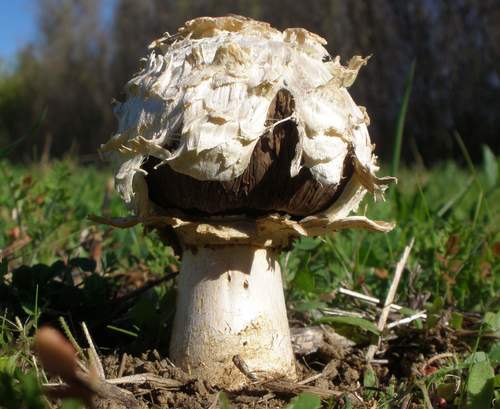
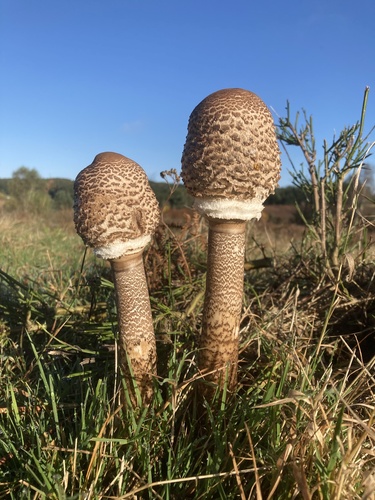
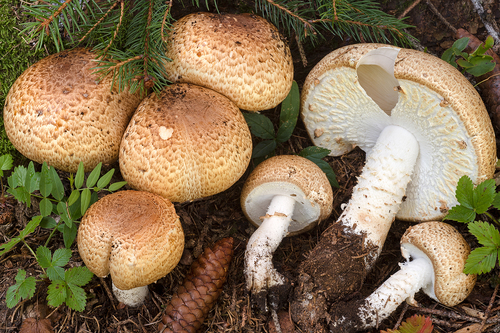
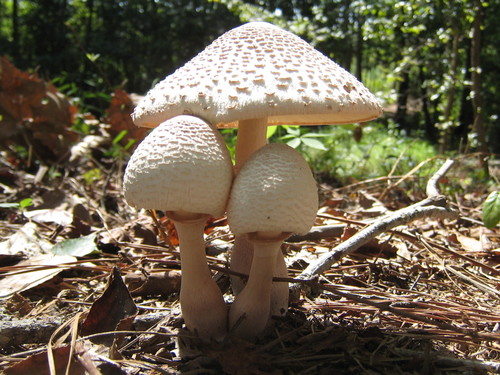
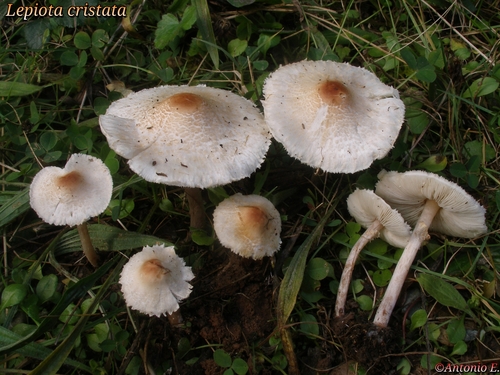
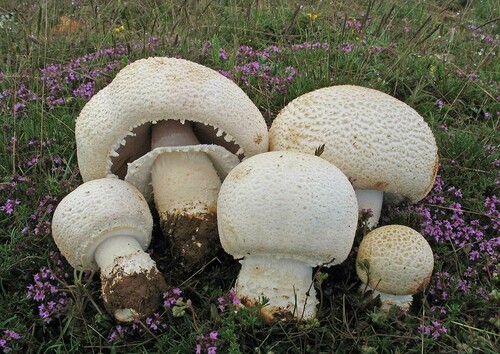
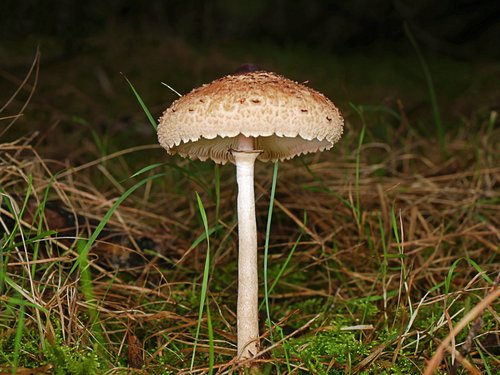
Macrolepiota clelandii Grgur. produces fruitbodies with caps that start egg-shaped, then become convex, and finally flatten when mature. Mature caps reach 7.6–12.5 cm (3.0–4.9 in) in diameter. The cap has a dark brown umbo, covered with small dark brown scales arranged in concentric rings that grow more dense toward the umbo; the dark brown scales reveal whitish flesh beneath. Small fragments of the partial veil may remain hanging from the cap margin. The gills are white, not attached to the stipe, closely spaced. The stipe is slender, hollow, up to 18.7 cm (7.4 in) long with a somewhat bulbous base. It is pale brown, and has a ring in its upper half that often detaches, becoming freely movable up and down the stipe. Mushrooms of this species have no distinctive odour. Their tall stature usually keeps gills clean by preventing contact with rain splash from the forest floor. Peter Roberts and Shelley Evans state that all parasol species, which include Macrolepiota procera and its close relatives such as M. clelandii, are edible. Anthony M. Young notes that M. clelandii is similar to the edible European species M. konradii, but warns that the toxicity of this Australian species is unknown. Macrolepiota clelandii produces a white spore print. Individual spores are ellipsoid, smooth, thick-walled, with a small germ pore, and measure 13.4–24.8 by 9.6–16.0 μm. Spores stain dextrinoid (reddish-brown) when tested with Melzer's reagent. The spore-bearing basidia are club-shaped, measuring 38.0–50 by 10.2–13.6 μm. Basidia can be two-, three-, or four-spored, with sterigmata up to 8.0 μm long. Collections with mostly four-spored basidia generally produce smaller spores than collections with two-spored basidia. Two-spored basidia produce spores that have four nuclei. Cheilocystidia are abundant on the gill edge; they are cylindrical to club-shaped, and measure 24.8–42.4 by 7.2–10.4 μm. No cystidia (pleurocystidia) are present on the gill face. Clamp connections are present in the hyphae. Macrolepiota clelandii fruits singly or in small groups, growing on the ground in grass or among leaf litter. It is typically found in eucalypt forest and subtropical rainforests. It has been recorded in Queensland, New South Wales, Victoria, South Australia, and Western Australia. In southwest Australia, it grows in jarrah (Eucalyptus marginata) and karri (Eucalyptus diversicolor) forests, where fruiting usually occurs in late autumn and early winter. The fungus appears to prefer disturbed ground, and is often found along forest roadsides, on lawns, in grassy park areas, and among slash from thinned karri regrowth forests. It is common in river red gum (Eucalyptus camaldulensis) woodlands. M. clelandii also occurs in New Zealand, where it grows in mixed mānuka (Leptospermum scoparium), kānuka (Kunzea ericoides), and kauri (Agathis) forest, as well as in conifer plantations. It is the smallest and most slender Macrolepiota species found in New Zealand.