About Macroglossum stellatarum Linnaeus, 1758
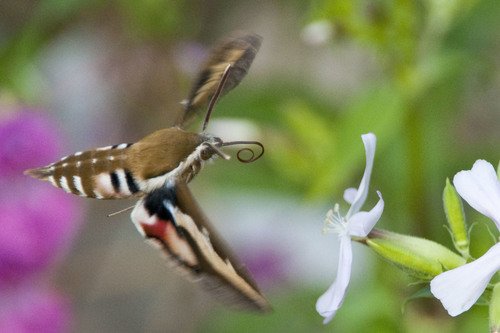
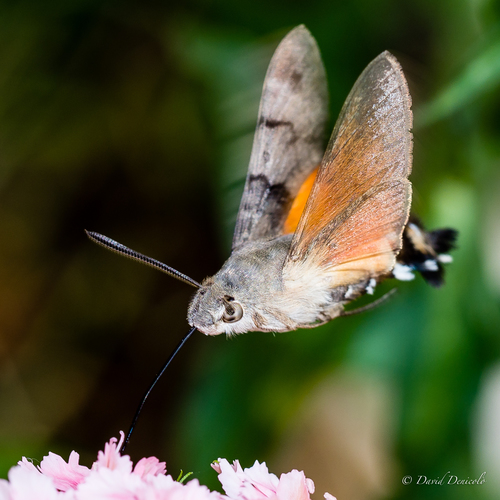
The hummingbird hawk-moth, Macroglossum stellatarum, is a species of hawk moth found across temperate regions of Eurasia. It is named for its strong similarity to hummingbirds: it feeds on nectar from tube-shaped flowers using its long proboscis while hovering in the air, and this shared resemblance is an example of convergent evolution. This species was first formally described by Carl Linnaeus in the 10th edition of his work Systema Naturae, published in 1758. As of 2018, the full mitogenome of this species has been sequenced. The hummingbird hawk-moth is distributed across the entire northern Old World, ranging from Portugal all the way to Japan. It breeds mainly in warmer climates, including southern Europe, North Africa, and areas further east. In Spain, the species produces three generations each year. There is documented evidence that the population of hummingbird hawk-moths in Britain and Ireland is actively expanding its range, as population numbers have increased consistently over time. Additionally, this population is thought to be becoming resident rather than migratory, because warmer temperatures from climate change allow individual moths to successfully overwinter. The species is a strong flier, and disperses widely during the summer. However, it rarely survives winter at more northern latitudes, such as areas north of the Alps in Europe, and areas north of the Caucasus in Russia. Moths of the genus Hemaris, which also belong to the family Sphingidae, are called "hummingbird moths" in the United States and "bee moths" in Europe. This common naming often causes confusion between Macroglossum stellatarum and this North American genus. Hummingbird hawk-moths are commonly seen in gardens, parks, meadows, bushy areas, and woodland edges, locations where their preferred food plants grow, including honeysuckle, red valerian, and many other species. Their larvae usually feed on bedstraws or madders of the genus Rubia, but have also been recorded feeding on other plants in the family Rubiaceae, as well as Centranthus, Stellaria, and Epilobium. Adult hummingbird hawk-moths are particularly fond of nectar-rich flowers that have a long, narrow calyx, because this allows them to use their long proboscis and avoid competition with other insect species. Flowers with longer tubes typically provide a higher nectar reward to feeding animals, and proboscis length in this species is thought to have been evolutionarily shaped by the length of these flower feeding tubes. Examples of these preferred flowers include Centranthus, Jasminum, Buddleia, Nicotiana, Primula, Viola, Syringa, Verbena, Echium, Phlox, and Stachys. The species is reported to practice trap-lining, meaning it returns to the same flower beds at around the same time each day. Hummingbird hawk-moths produce two or more broods each year. Adult moths can be encountered at any time of year, especially in the southern part of the species' range, where there may be three or four broods annually. It overwinters as an adult, hiding in crevices among rocks, trees, and buildings. On unusually warm winter days, adult moths may emerge to feed even in mid-winter. Unlike many other moth species, hummingbird hawk-moths do not have sexual dimorphism in the size of their antennal lobes.