About Macrodontia cervicornis (Linnaeus, 1758)
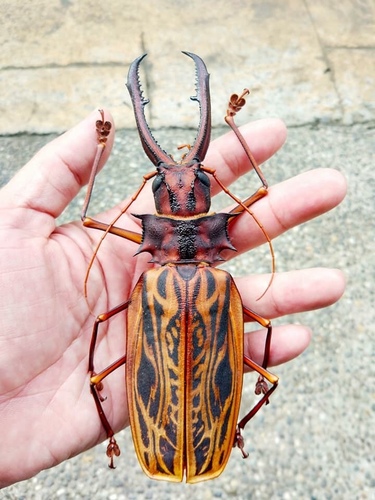
Macrodontia cervicornis (Linnaeus, 1758), commonly called the sabertooth longhorn beetle, ranks among the largest beetle species when the enormous mandibles of male individuals are included in length measurements. The two parts of its scientific binomial name both refer to these prominent male mandibles: Macrodontia translates to "long tooth", and cervicornis translates to "deer antler". Standard measurements of insect length typically exclude legs, mouthparts like jaws, or horns. When mandibles are included in total length, the longest known M. cervicornis specimen reaches 17.7 cm. For comparison, the longest known specimen of Dynastes hercules, a beetle species with large horns, measures 17.5 cm when its horns are included, while the longest known beetle when neither jaws nor horns are counted is Titanus giganteus, at 16.7 cm. Most of this species' total lifespan is spent in the larval stage, which can last as long as 10 years. The adult phase of M. cervicornis only lasts up to a few months, and adults use this time to disperse and reproduce. Females lay their eggs under the bark of dead or dying softwood trees. After hatching, larvae burrow into the rotting wood of the host tree, creating large extensive galleries that can reach over one metre in length and 10 centimetres in width. This species occurs in the rain forests of Colombia, Ecuador, Peru, Bolivia, the Guianas, and Brazil.