About Macracantha arcuata (Fabricius, 1793)
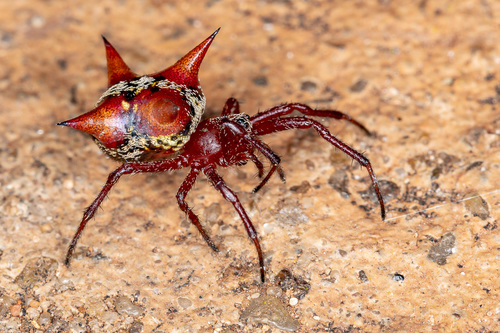
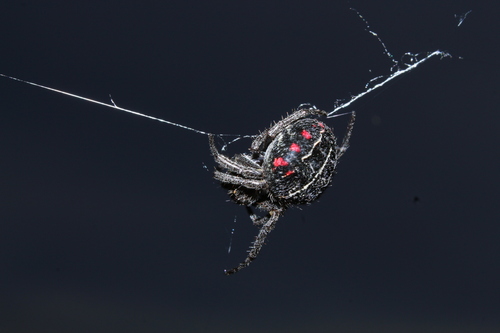
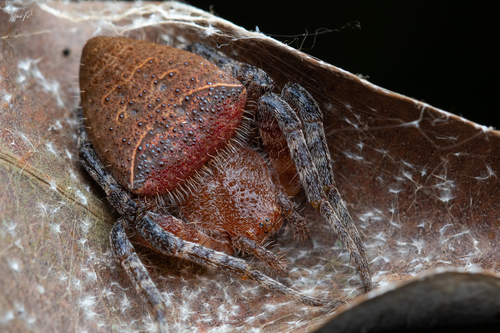
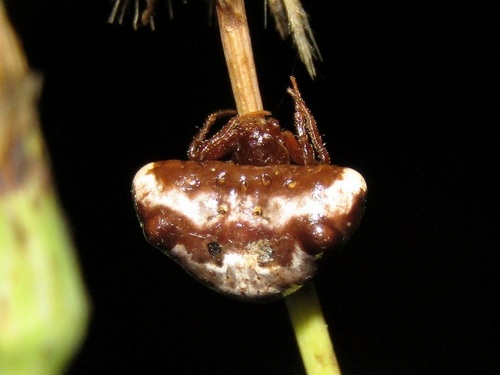
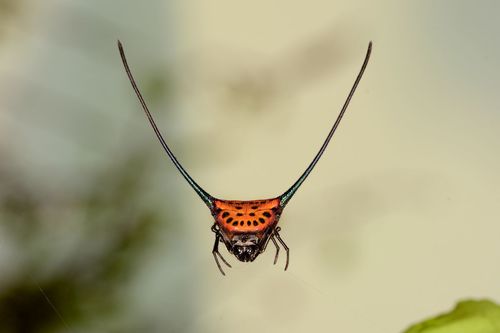
Females of this species, in the genus Macracantha, have tough, shell-like abdomens that bear three pairs of spines. The prominent median, or middle, spines project upward and outward, curving toward each other along their length. These median spines can reach up to 20 to 26 mm long, which is up to three times the 8 to 9 mm width of the abdomen. The anterior, or front, and posterior, or rear, spines are short, relatively unnoticeable, and roughly equal in length to each other. The upper surface of a female's abdomen ranges in color from yellow to red, and can also be white or black, and is marked with black sigilla. The ventral, or lower, surface of the abdomen has yellow or orange markings, and the median spines can display bluish iridescence. Males of the species reach only 1.5 mm in size, and have stout, conical spines. In terms of ecology, female M. arcuata build orb webs that are three or four feet wide in forested areas. These webs feature hollow hubs and white silk beads on the radial threads. Researchers Siliwal and Molur report that females were more often found on the undersides of leaves near their webs than hanging in the center of the web. A study conducted in Singapore found that this species appears to rely heavily on primary tropical forest.