About Maclura pomifera (Raf. ex Sarg.) C.K.Schneid.
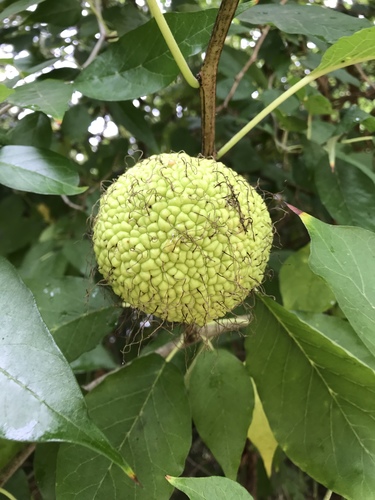
Maclura pomifera (Raf. ex Sarg.) C.K.Schneid., commonly known as the Osage orange, is a small deciduous tree or large shrub in the mulberry family (Moraceae), native to the south-central United States. It is not related to citrus oranges despite its common name. It typically grows 8 to 15 m (30–50 ft) tall. Its distinctive clustered multiple fruit resembles an immature orange: it is roughly spherical, bumpy, 8 to 15 cm (3–6 in) in diameter, and turns bright yellow-green in the fall. The fruit releases sticky white latex when cut or damaged. Due to its latex content and woody pulp, the fruit is not usually eaten by humans and is rarely consumed by foraging animals; it is not poisonous to humans or livestock, but is largely inedible due to its large size (roughly softball diameter) and hard, dry texture, though its edible seeds are eaten by squirrels. The species has many additional common names: mock orange, horse apple, hedge apple, hedge ball, monkey ball, pap, monkey brains, and yellow-wood. The French name bois d'arc (meaning "bow-wood") has also been corrupted into bodark and bodock. In pre-Columbian times, Osage orange’s native range was largely restricted to a small area of what is now the United States: the Red River drainage of Oklahoma, Texas, and Arkansas, as well as the Blackland Prairies and post oak savannas. A separate disjunct population also grew in the Chisos Mountains of Texas. It has since become widely naturalized across the United States and Ontario, Canada, and has been planted in all 48 contiguous U.S. states and southeastern Canada. It has also been transplanted and planted in many parks across Europe, where it is found in Bulgaria and Serbia. The largest known Osage orange tree grows at the Patrick Henry National Memorial in Brookneal, Virginia, and is thought to be almost 350 years old. Another historic individual stands on the grounds of Fort Harrod, a Kentucky pioneer settlement in Harrodsburg, Kentucky. Because of its limited original range and lack of an obvious effective modern seed propagation method, some authors have controversially proposed Osage orange fruit as an example of an evolutionary anachronism. Ecologists Daniel H. Janzen and Paul S. Martin first suggested this hypothesis in 1982: the idea that the fruit coevolved with a large animal seed dispersal partner that is now extinct. Proposed extinct dispersal agents include one or more species of Pleistocene megafauna, such as ground sloths, mammoths, mastodons, or gomphotheres, as well as an equine species that went extinct at the end of the Pleistocene, since modern horses and other livestock sometimes eat the fruit. This hypothesis remains controversial. A 2015 study found Osage orange seeds are not effectively spread by living horse or elephant species, while a 2018 study concluded squirrels are only ineffective, short-distance seed dispersers. The anachronism hypothesis has been criticized as a "just-so story" lacking empirical evidence. In modern wild ecology, the fruit is eaten by black-tailed deer in Texas, and by white-tailed deer and fox squirrels in the Midwest; crossbills are reported to peck out and eat the seeds. Loggerhead shrikes, a species declining across much of North America, use Osage orange trees for nesting and cache their prey on the tree’s thorns. In cultivation, Maclura pomifera prefers deep, fertile soil, but is hardy across most of the contiguous United States, where it has long been grown as a hedge. It requires regular pruning to stay within intended size bounds; its new annual shoots grow 1 to 2 m (3–6 ft) long, making it suitable for coppicing. A hedge that is not pruned will develop fruit. The species is remarkably resistant to insect pests and fungal diseases. A thornless male cultivar exists, and is propagated vegetatively for ornamental use. M. pomifera is also cultivated in Italy, the former Yugoslavia, Romania, the former USSR, and India. Osage orange has a wide range of uses. It is commonly planted in tree rows as windbreaks in prairie states, which gave it the common name "hedge apple". It was one of the main tree species used in U.S. President Franklin Delano Roosevelt’s 1934 "Great Plains Shelterbelt" WPA project, an ambitious initiative to modify regional weather and prevent soil erosion in the Great Plains states. By 1942, the project resulted in 30,233 shelterbelts holding 220 million trees, stretching 18,600 miles (29,900 km). Before barbed wire was introduced, the sharp-thorned trees were planted as cattle-deterring hedges; after barbed wire’s introduction, they became an important source of fence posts. In 2001, Osage orange wood was used to build the schooner Sultana, a replica of HMS Sultana, in Chestertown, Maryland. The tree’s heavy, close-grained yellow-orange wood is dense, rot-resistant, dimensionally stable, and prized for tool handles, treenails, fence posts, and other applications that require strong, long-lasting wood. While the wood is often knotty and twisted, straight-grained Osage orange timber makes excellent bows, a use historically practiced by Native Americans. In the early 19th century, Scottish botanist John Bradbury — who traveled extensively through the interior of the United States — reported that an Osage orange bow could be traded for a horse and a blanket. A yellow-orange dye can also be extracted from the wood, and used as a substitute for fustic and aniline dyes. Today, florists use the tree’s distinctive fruits for decorative purposes. When dried, Osage orange wood has the highest heating value of any commonly available North American wood. It is more rot-resistant than most North American woods, so it makes excellent fence posts. Posts are generally set while the wood is still green, because dried Osage orange wood is too hard to reliably accept the staples used to attach fencing. Palmer and Fowler's 2nd edition Fieldbook of Natural History rates Osage orange wood as at least twice as hard and strong as white oak (Quercus alba). Its dense grain structure creates good tonal properties, so it is commonly used to make woodwind instruments and waterfowl game calls. Concentrated compounds extracted from the fruit may repel insects, but the natural concentration of these compounds in whole fruit is too low to make the fruit an effective insect repellent. In 2004, the EPA required a website selling M. pomifera fruits online to remove all claims of the fruit’s supposed insect repellent properties, as these claims were false advertising. The Comanche people historically used a decoction of the plant’s roots as a topical wash to treat sore eyes.