About Macleaya cordata (Willd.) R.Br.
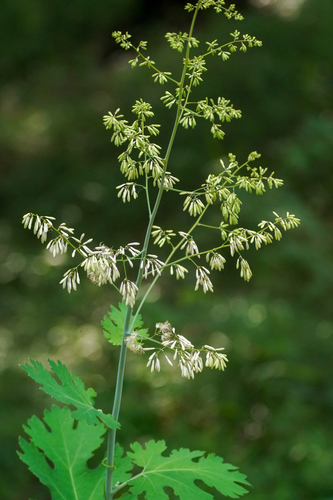
Macleaya cordata, commonly called five-seeded plume-poppy, is a flowering plant species in the poppy family Papaveraceae, grown for ornamental purposes. It is native to China and Japan. This plant is a large herbaceous perennial that grows to 2.5 meters (8 feet) tall and spreads 1 meter (3 feet) or more wide. It produces olive green leaves and airy panicles of buff-white flowers during the summer. In cultivation, Macleaya cordata self-seeds readily and can become invasive, so it needs plenty of space to grow. It is a popular plant for use in flower arranging, and it has earned the Royal Horticultural Society's Award of Garden Merit. Macleaya × kewensis, a hybrid developed at Kew Gardens, is the result of crossing M. cordata and M. microcarpa. The cultivar 'Flamingo', which has pink-tinged flowers, has also received the Award of Garden Merit. Macleaya cordata is a source of a variety of chemical compounds, most of which are isoquinoline alkaloids. Its seed oil contains dihydrosanguinarine, dihydrochelerythrine, and twelve fatty acids. Linoleic, oleic, palmitic and stearic acids are the most abundant fatty acids in this oil.