About Machetornis rixosa (Vieillot, 1819)
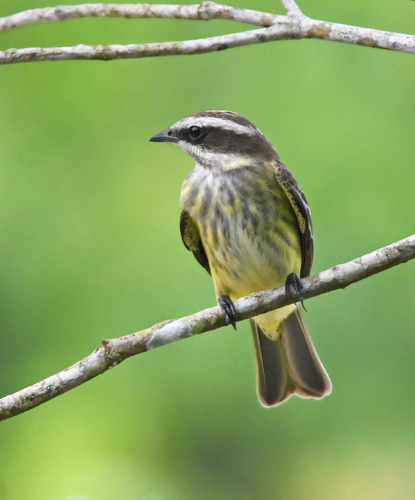
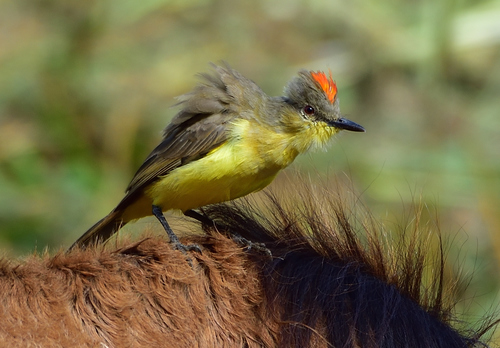
This species is commonly known as the cattle tyrant, a highly terrestrial tyrant flycatcher. It measures 19.5–20 cm (7.7–7.9 in) in length and weighs 29–40 g (1.0–1.4 oz). For the nominate subspecies, plumage is mostly olive-brown on the upper body and yellow on the lower body. It has a grey head with a thin dark eyestripe, a paler whitish throat, and thin black bill and legs. The other two accepted subspecies differ from the nominate: their heads are less grey, and match the olive-brown color of the back more closely, while their throats are yellower.
George Robert Gray gave this species its genus name, which derives from the Ancient Greek words makhētēs (fighter) and ornis (bird). This name refers to the species' pugnacious behavior, including its habit of taking over nests built by other species. The specific name comes from the Latin word rixosus, which means quarrelsome, and also references the species' behavior and temperament. The cattle tyrant has a disjunct distribution, with three currently accepted subspecies. The nominate subspecies M. r. rixosa (Vieillot, 1819) is found in eastern South America, ranging from northern Argentina and Bolivia to the northeastern tip of Brazil. M. r. flavigularis Todd, 1912 occurs in southernmost Central America and northwestern South America, from Panama to western Colombia and western Venezuela. M. r. obscurodorsalis W. H. Phelps & W. H. Phelps Jr, 1948 lives in north-central South America, from eastern Ecuador through central Colombia to eastern Venezuela. The two northern subspecies are only partly separated by the Andes, with some range overlap in Venezuela. They are not very distinct from one another, and may be better merged under the older name M. r. flavigularis. This species lives in drier open and semi-open habitats, and avoids forested and wooded areas. It can be found in savannah, pastureland, parkland, agricultural land, and even gardens. As a result of deforestation, the species has recently colonized areas where it did not previously occur, such as northeast Ecuador.