About Machaerina juncea (R.Br.) T.Koyama
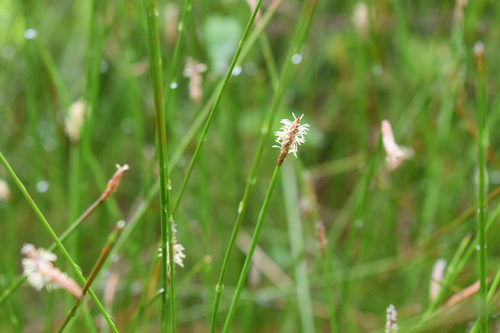
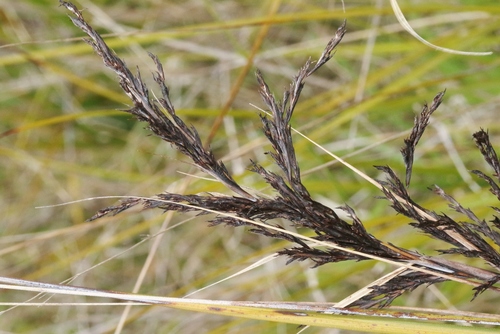
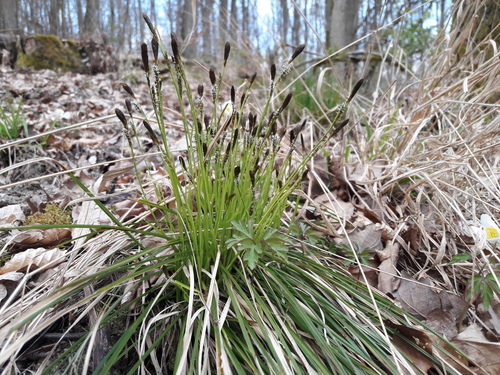
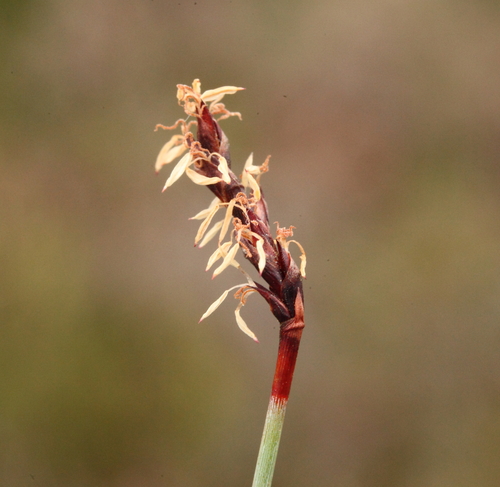
Machaerina juncea (R.Br.) T.Koyama is a perennial, rhizomatous sedge with a grass-like appearance. It usually grows 0.2 to 1.2 metres (0.7 to 3.9 ft) tall and spreads to form colonies easily. Its rhizome is woody, short-creeping, 3 to 10 millimetres (0.118 to 0.394 in) in diameter, and covered in light brown, papery, loose, overlapping imbricate bracts. Terete, rigid, erect, smooth, glaucous culms grow in crowded tufts along the rhizome, and each culm has one to two widely spaced nodes. Its leaves take the form of light brown or reddish sheathing bracts. This species blooms between October and March, producing brown flowers. Each inflorescence is stiff, erect, spike-like, and sparingly branched, measuring 25 to 100 mm (1.0 to 3.9 in) in length, with a much shorter sheathing bract positioned beneath it. The red-brown spikelets are 4 to 5 mm (0.157 to 0.197 in) long and hold one or two flowers each. After flowering, it forms an oblong to ovoid shaped nut that is 2.5 to 3 mm (0.098 to 0.118 in) long; the nut is dark brown to black, with an orange coloration near its base.
In New Zealand, this species is common across the North Island and occurs less frequently on the South Island. It grows from coastal areas up to lower montane elevations, in and around swamps, salt marshes, lake margins, and river estuaries. In Australia, it is found in coastal areas of all states. In Western Australia, it occurs in coastal regions of the Mid West, Wheatbelt, Peel, South West, Great Southern, and Goldfields-Esperance areas, where it grows in water-logged sandy soils.