About Macaria abydata Guenée
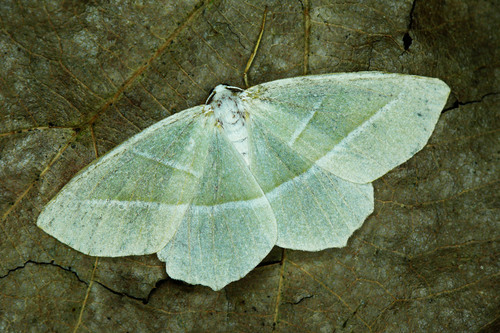
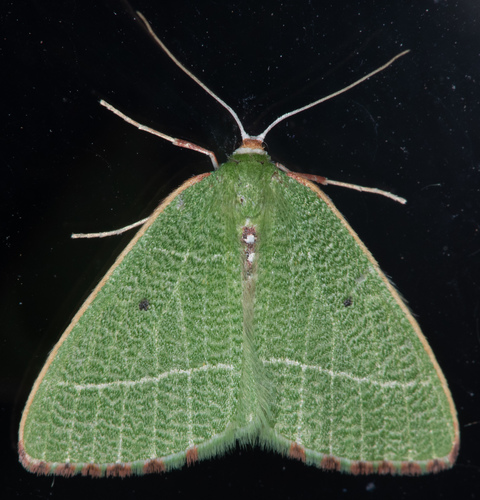
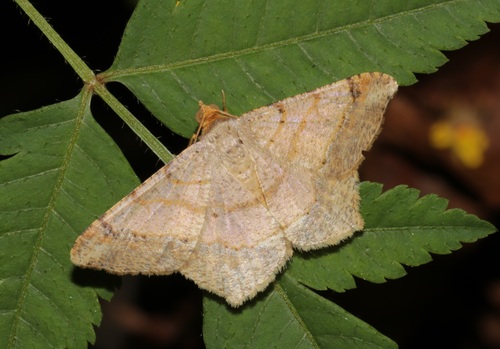
Macaria abydata, commonly called the dot-lined angle, is a moth belonging to the family Geometridae. It is native to the region extending from northern Argentina to the Caribbean and the southern United States, including southern states from Arizona to Florida. It regularly wanders north into Colorado, Kentucky, and other more northerly U.S. states. It has been introduced to the Pacific region and has spread rapidly since its first introduction there. The first recorded introduction to the Pacific was in Hawaii in 1970, and it was recorded on all of Hawaii's main islands by 1984. Its further spread across the Pacific followed this timeline: 1975, Yap in central Micronesia; 1976, Bonin Islands (Chichi-jima and Haha-jima); 1977, Saipan in central Micronesia, recorded in 1985; 1980, Okinawa Island; 1983, Taiwan; 1985, Guam in central Micronesia; 1986, Sulawesi; 1986, Tonga (recorded 1985), Fiji (recorded 1985), Miyako Islands (Miyako-jima), and Luzon, the Philippines (recorded 1985); 1987, New Caledonia (recorded 1985), and Sabah, Malaysia; 1988, western Samoa (recorded 1985); 1992, Hong Kong. This moth has a wingspan of 22–27 mm, equal to 0.87–1.06 inches. Its common name "dot-lined" refers to the small dots that run along the postmedial line, and sometimes the median line, of both the forewings and hindwings, located anterior to the marginal band. In the species' native range, recorded host plants for its larvae are Vachellia farnesiana, Cassia, Sesbania, Parkinsonia aculeata, and Glycine max. In Hawaii, larvae have been observed feeding on Acacia koa, introduced Lysiloma latisiliquum, and Litchi chinensis. In the Indo-Australian tropics, the species has been reared from larvae collected on Leucaena and Mimosa diplotricha.