About Macaranga tanarius (L.) Müll.Arg.
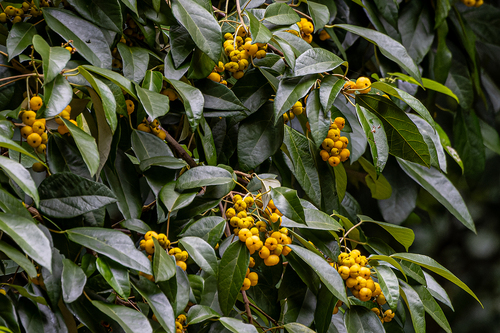
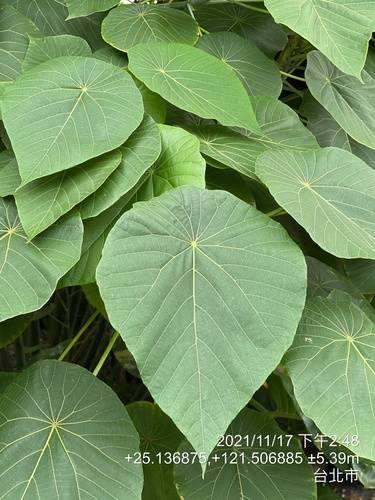
Macaranga tanarius (L.) Müll.Arg. is a shrub or bushy tree that can sometimes grow 12 metres tall, with a stem diameter of up to 40 cm. Its trunk is short and crooked, and its grey-brown bark is marked by bumps and irregularities. Smooth, bluish grey branchlets bear prominent leaf scars. Leaves are alternate, rounded with a pointed tip, and measure 8 to 23 cm in length. The underside of the leaves is greyish or white. Prominent 8 to 20 cm long leaf stalks connect to the interior of the leaf blade. Nine main veins radiate out from the leaf stalk, and are easily visible on both the upper and lower sides of the leaf. Yellow-green flowers grow in panicles between October and January in New South Wales. Female and male flowers are borne on separate individual trees. The fruit is a prickly, three-celled yellow capsule 9 mm in diameter, which matures between January and February in New South Wales. Each cell of the fruit holds one black seed. Germination from fresh seed happens easily, and cuttings root successfully. This species is grown as an attractive ornamental tree valued for its distinct interesting leaves. Bush regenerators also favor it, as it provides shade for young juvenile trees. Tannins found in its bark are used as a colorant: it is applied to dye nets and mats, used as a type of house paint, and used as a leather preservative during tanning. In the Philippines, specifically in the Ilocos Region and Apayao, the tree is locally known as samak, and is widely used to produce traditional basi, a sugarcane-based rum, as well as local vinegar. Various parts of the tree including dried leaves, bark, fruits, and flowers are used as fermenting, coloring, and flavoring agents during the fermentation process of these products.