About Macaranga peltata (Roxb.) Müll.Arg.
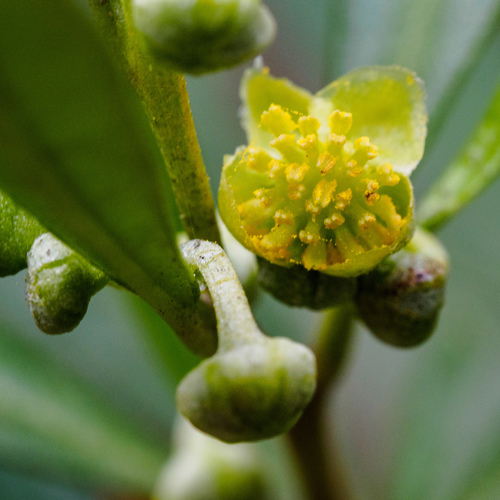
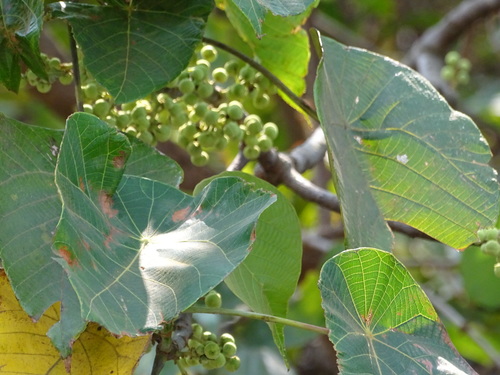
Macaranga peltata (Roxb.) Müll.Arg. is a resinous tree that can reach up to 10 metres (33 ft) in height. Its young growing parts are covered in velvet-like hairs. Leaves are alternately arranged, measure 20 to 50 centimetres (7.9 to 19.7 in) long by 12 to 21 centimetres (4.7 to 8.3 in) wide, have a circular or broadly ovate shape, can be entire or minutely toothed, and are palmately 9-nerved. The leaf stalk attaches to the lower surface of the leaf, not at the leaf base. Yellow-green flowers grow in long panicles in leaf axils from January to February. Male flowers are very small, numerous, and clustered in the axils of large bracts. It produces a spherical capsule 4 to 5 mm across that holds one round, black seed. Mallotus tetracoccus is a pioneer or early-successional/early-secondary tree species that is more abundant in forest edges, clearings, and secondary forests than in the interiors of mature forests. Ecophysiological studies show that Macaranga peltata has a combination of high quantum use efficiency of the photosynthetic system (Fv/Fm) and high relative growth rates under higher light conditions, which follows a pattern similar to other pioneer species like Mallotus tetracoccus. Locally called kenda, leaves of this species are commonly used for flavoring food in Sri Lanka. Halapa dough is often flattened on a kenda leaf to absorb the leaf's flavor. Kenda leaves are also used to wrap jaggery and other sweetmeats. In coastal regions of the Indian state of Kerala, local fish vendors use these leaves to wrap fish. Currently, the main commercial use of Macaranga peltata is for making wooden pencils and for the plywood industry. The city of Kollam produces 75 to 100 truck loads of pencil slats from this species each period.