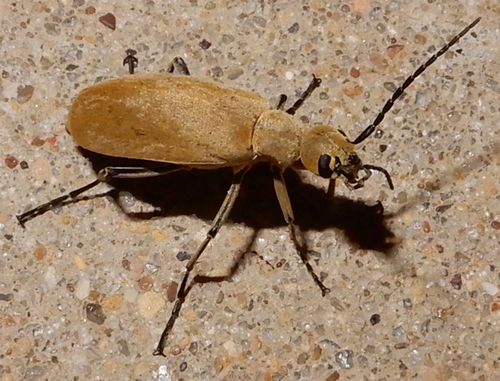
About Lytta nuttallii Say, 1824
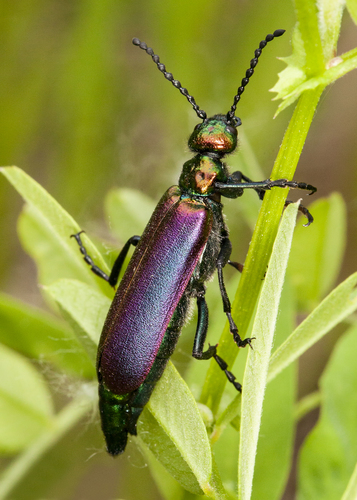
Lytta nuttallii Say, 1824, commonly called Nuttall's blister beetle, is a species of North American beetle first formally described in 1824 by Thomas Say. The name of the genus Lytta comes from a Latin word that means madness. The specific epithet nuttallii honors the work of Thomas Nuttall, who was a contemporary of Thomas Say. Nuttall's blister beetles have a brilliant iridescent exoskeleton in purple and green, which stands out sharply against the prairie plants that grow in their native habitat. This species occurs in Canada, ranging from Alberta to Manitoba, and in the United States, ranging from Idaho south to Arizona, and east to Minnesota and New Mexico. A separate disjunct population of this species is found in eastern California, limited only to higher altitude areas. This species is one of more than 3,000 species that belong to the family Meloidae, commonly known as blister beetles. Adult beetles of all species in this family can produce cantharidin, an irritating defensive chemical that discourages predators. The larvae of Lytta blister beetles develop inside the nests of solitary bees from the family Apidae, where they feed on bee larvae and the stored food the bee collected for its own young. As adults, Nuttall's blister beetles feed in groups on green plants, with a particular preference for legumes. This grouping feeding behavior can cause issues for farmers when the beetles feed on crops including soybeans, sweetclover, alfalfa, and other cultivated plants. Animals that consume these beetles alongside hay or forage can be poisoned by the cantharidin that the beetles produce as a chemical defense. Nuttall's blister beetles are not classified as a serious agricultural pest, because their population sizes are naturally limited by their larval requirement for native ground-nesting bees to develop.