About Lythrum salicaria L.
Size and Growth Habit
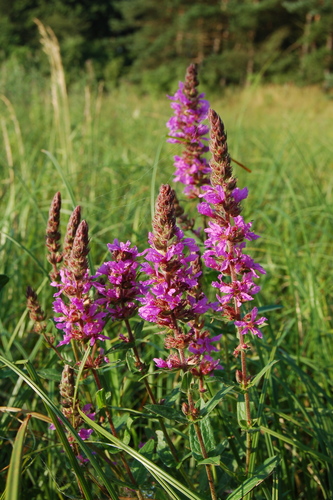
Lythrum salicaria L. grows 1–2 m (3 ft 3 in – 6 ft 7 in) tall, forming extensive clonal colonies where numerous erect stems grow from a single woody root mass.
Stem Characteristics
Stems are reddish-purple and square in cross-section.
Leaf Characteristics
Leaves are lanceolate, 3–10 centimetres (1–4 in) long, 5–15 millimetres (3⁄16–9⁄16 in) broad, downy, and sessile, arranged opposite each other or in whorls of three.
Flower Appearance
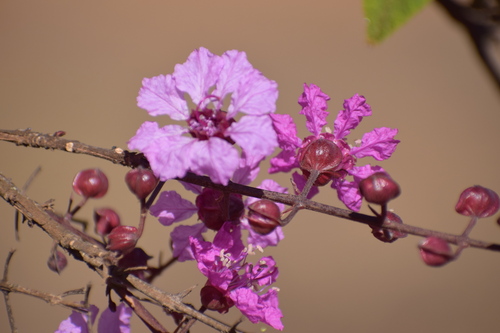
The flowers are reddish purple, 10–20 millimetres (1⁄2–3⁄4 in) in diameter, with six petals (occasionally five) and 12 stamens, clustered tightly in verticillasters in the axils of bracts or leaves.
Heterostyly System
There are three distinct flower types, each with stamens and style of different lengths: short, medium, or long. Each flower type can only be pollinated by one of the other two types, never the same type, which ensures cross-pollination between different plants. For example, if the pistil is medium length, the stamens will be long and short, not medium.
Pollination Mechanism
Many types of insects visit the flowers, giving this species a generalised pollination syndrome.
Fruit and Seeds
The fruit is a small 3–4 millimetre (1⁄8–5⁄32 in) capsule that holds numerous minute seeds.
Flowering Period
Flowering occurs throughout the summer.
Autumn Foliage
When seeds reach maturity in early autumn, leaves often turn bright red through dehydration, and this red autumn colour can last for almost two weeks.
Dead Stalks
Dead stalks left over from previous growing seasons are brown.
Taxonomic Variation
L. salicaria varies widely in leaf shape and the degree of hairiness, and a number of subspecies and varieties have been described in the past, but it is now generally considered monotypic, with none of these variants recognised as botanically significant.
Related Species Status
The species Lythrum intermedium Ledeb. ex Colla was often treated as synonymous with L. salicaria in the past, but the Plants of the World Online database now recognises it as a separate species native to Central Asia.
Native Range
Lythrum salicaria is native to Europe, temperate Asia, northern Africa, and Australia.
Naturalised Range
It is also naturalised in many temperate regions around the world, including parts of southern Africa, North America, and South America.
Australian Colonisation Status
It was long thought to be a recent introduction to Australia, but pre-colonial pollen samples have been found in New South Wales, indicating natural colonisation occurred before modern human plant introductions; Australian authorities consider this question unresolved.
Typical Habitat
This species grows in ditches, wet meadows, and marshes, and along the edges of lakes.
North American Invasion Habitat
In North America, it can invade sedge meadows.
Medicinal Uses
It has been used as an astringent medicinal herb to treat diarrhea and dysentery, and is considered safe for use by all age groups, including babies.
Ornamental Cultivation
It is also grown as an ornamental plant in gardens, and is particularly associated with damp, poorly drained locations such as marshes, bogs, and watersides, though it can tolerate drier conditions.
Flower Cultivars
Its flowers are showy and bright, and a number of cultivars have been selected for variation in flower colour: 'Atropurpureum' with dark purple flowers, 'Brightness' with deep pink flowers, 'Happy' with red flowers on a short (60 cm or 24 in) stem, 'Purple Spires' with purple flowers on a tall stem, and 'Roseum Superbum' with large pink flowers.
Award-Winning Cultivars
The cultivars 'Blush' with blush-pink flowers and 'Feuerkerze' with rose-red flowers have received the Royal Horticultural Society's Award of Garden Merit.
Beekeeper Introduction
It has also been introduced to many areas of North America by beekeepers, because its abundant flowers provide an important source of nectar.