About Lysurus periphragmoides (Klotzsch) Dring
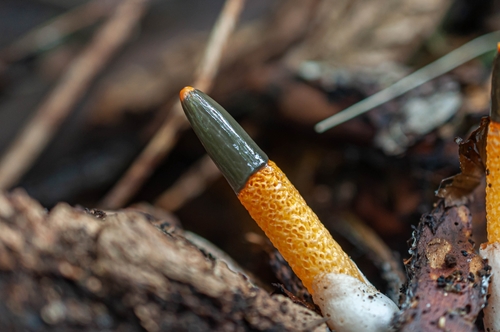
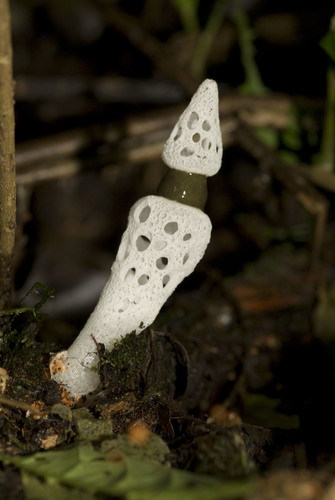
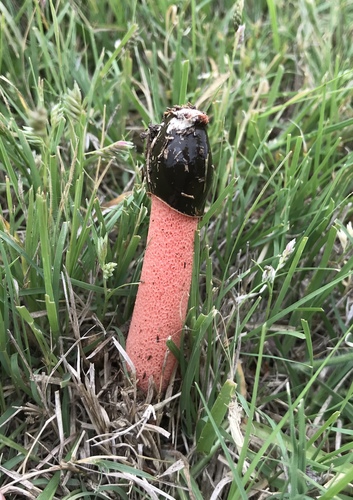
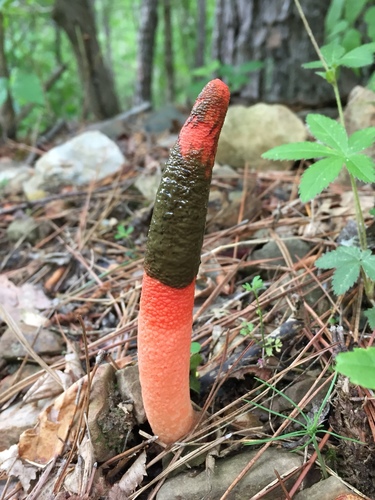
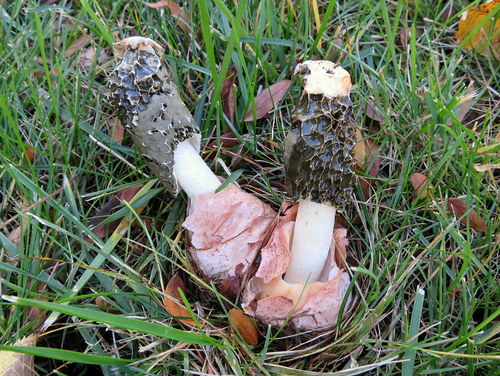
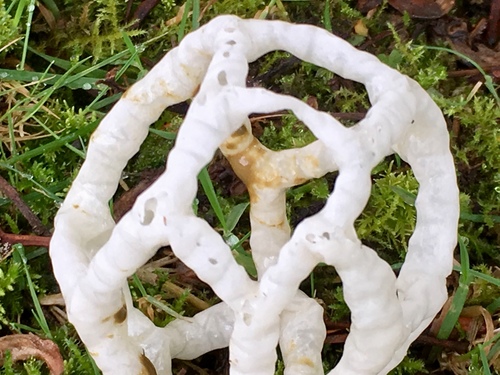
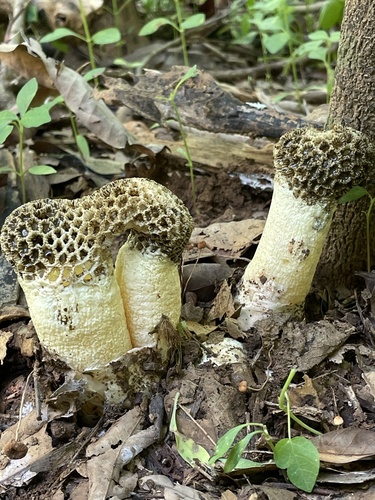
Immature fruiting bodies of Lysurus periphragmoides start as round or oval "eggs" that can reach up to 5 cm (2 in) in diameter. Whitish rhizomorphs on the underside of the egg anchor it to the growing substrate. The peridium is white to buff-colored on its outer surface, with a gelatinous layer located inside. Cutting an egg lengthwise exposes its distinct internal layers: a tough white outer peridium, and a thick layer of firm, translucent gelatinous matter crossed by strands (trabeculae) of denser white tissue. These strands are anastomosing partitions that connect to the peridium externally and to the bars of the internal receptaculum, dividing the gelatinous layer into many irregular longitudinal chambers. As the stalk expands and pushes through the egg, the egg eventually ruptures, leaving a volva at the base of the stipe. Mature fruit bodies grow up to 15 cm (6 in) tall, with a latticed spherical cap (called the receptaculum) sitting atop a long yellow or reddish stipe. Generally, specimens from the Old World tend to be yellow, while New World specimens are reddish, though exceptions to this trend have been recorded in published literature. The receptaculum is typically 1.5–3.5 cm (1⁄2–1+1⁄2 in) in diameter, and forms a red or orange lattice, or mesh. The receptaculum usually holds between 20 and 100 small pentagonal to hexagonal meshes. The mesh arms have sharp ridges on their outer surface, corrugations on their sides, and are flat to weakly ridged on their inner surface. The internal surfaces of the receptaculum are covered with an olive-green spore-bearing gleba, which sometimes seeps through the holes in the mesh. Like most stinkhorn species, the gleba has a foul odor similar to rotten meat, but it is less offensive than the gleba of most other stinkhorns. Fresh, newly exposed gleba has been reported to smell sweet, comparable to amyl acetate; the foul odor only develops after the gleba has been exposed to air for some time. The stipe is 5–15 cm (2–6 in) long, 0.8–3 cm (1⁄4–1+1⁄4 in) thick, hollow, and spongy. Its walls are composed of an inner layer of large tubes, plus two or three outer layers of small tubes. Rarely, specimens may be found with fused heads growing from two separate stipes that arise from a single volva. A variety with a white fruit body is recognized: Lysurus periphragmoides var. albidum, originally described as Simblum texense var. albidum by Long. It was recorded growing in sandy alkaline soil in semi-arid regions of New Mexico, and has not been reported again since Long's 1941 collections. This species is typically found growing solitary or in groups on lawns, mulch, pastures, and open woods. A North American field guide notes an association with apple orchards and cornfields. Lysurus periphragmoides has a pantropical distribution. It has been reported from Africa (Mauritius, Tanzania), Asia (Jilin Province, China, Sri Lanka, India, Pakistan, Thailand, Indonesia), with its distribution extending north to Asia's Ryukyu Islands, Australasia (New Guinea), North America (Bahamas, Dominica, Mexico), Central America (Nicaragua), and South America (Argentina, Uruguay, Brazil, Venezuela). It is fairly common in South America, and in southern North America it usually only appears during periods of wet weather. Like many stinkhorns, Lysurus periphragmoides is generally considered edible only when it is in its immature "egg" form.