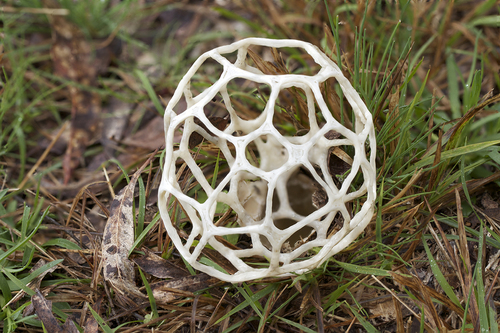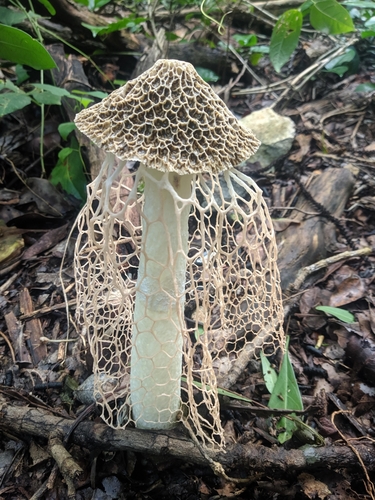
About Lysurus mokusin (L.) Fr.
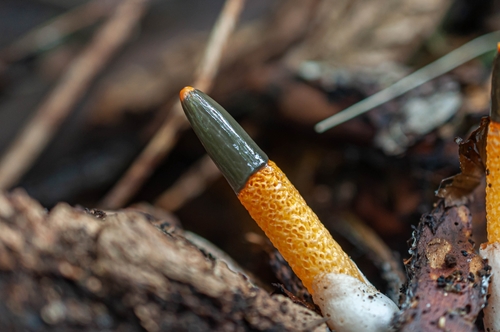
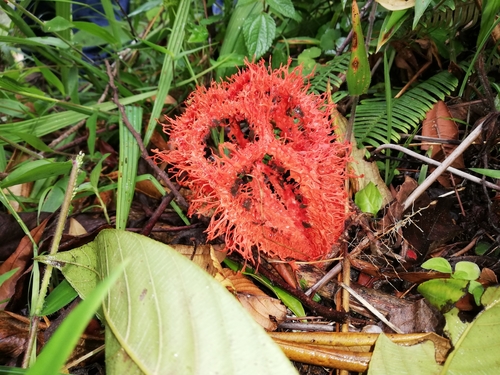
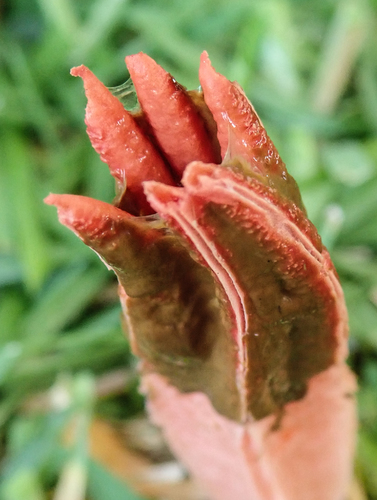
Immature fruit bodies of Lysurus mokusin are white, gelatinous "eggs" 1–3 cm (1⁄2–1+1⁄4 in) in diameter. These immature structures are anchored to the ground by thickened mycelial strands called rhizomorphs. As the fungus matures, the expanding fruit body ruptures the egg, leaving volval remnants at the base of the structure. Mature fruiting bodies are hollow and spongy, with a stipe that measures 10–15 cm (4–6 in) long by 1.5–2.5 cm (1⁄2–1 in) wide. Stipe color ranges from white to pink to red, and it has 4–6 distinct, deeply grooved sides separated by lengthwise ribs. The angular shape of this stipe is the key feature that distinguishes L. mokusin from other species in the genus Lysurus. The stipe’s sides extend into 4–6 arms, which are fused at the tip to form a pointed apex that resembles a spire. As the mushroom matures, these arms may spread apart. The outer surface of the arms is covered by a brownish, slimy, foul-smelling spore mass called the gleba. The fetid odor of the gleba attracts flies and other insects, which help disperse the fungus’s spores. The odor has been described as similar to fresh dog feces, rotting flesh, or sewage. L. mokusin spores are cylindrical, smooth, thin-walled, and hyaline (translucent), with dimensions of 4–6 by 2–2.5 μm. Scanning electron microscopy shows one end of each spore has a hilar scar, an indentation in the spore wall that forms when the spore separates from the sterigma of the basidium. The spore-bearing basidia of this species are usually eight-spored. The gleba is made up of chains of roughly spherical, fusiform, ellipsoid to broadly club-shaped cells, which fall into two size groups: 6.5–7.4 by 2.8–5.6 μm, or 37.1–46.3 by 18–28 μm. These cell types are also mixed with filamentous cells 2.3–4.5 μm wide. The hyphae of L. mokusin have clamp connections. Lysurus mokusin is a saprobic species. It grows either solitarily or in small groups in forest litter, wood chip mulch used for landscaping, and compost. Documented distribution of L. mokusin includes Australasia, the Canary Islands, Korea, Japan, Fujian Province in China, and the Bonin Islands. The species was not recorded in Europe until a 1979 report from Italy, and it is considered an alien species on the continent. In the United States, it has been collected from California, Texas, Northeast Oklahoma, and Washington, D.C. This species is considered edible when it is still in the immature "egg" stage, and it is regarded as a delicacy in China. Most people are deterred from eating mature specimens by their strong foul odor. In China, the fungus has also been used medicinally as a remedy for ulcers.