About Lyssomanes viridis (Walckenaer, 1837)
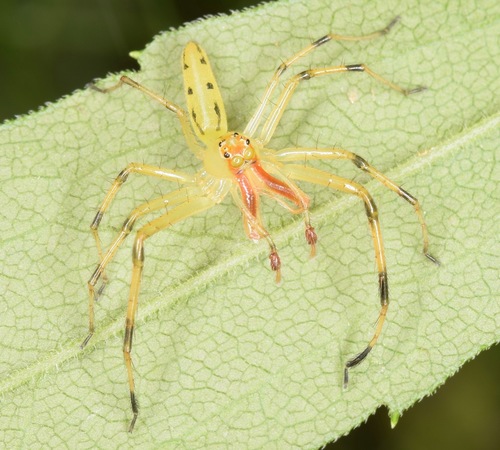
The magnolia green jumping spider, Lyssomanes viridis, is small for a jumping spider. Adult females reach 7-8 millimeters in body length, while adult males measure 5-6 millimeters. Most individuals are pale, partially translucent green — this color gives the species part of its scientific and common name. They have a small fringe of scales that can appear red, orange, yellow, or white on the crown of the head, framing the eyes. Compared to most jumping spiders, L. viridis has longer legs relative to its body, and a shorter maximum leap, reaching approximately three to four times its body length. Like most other jumping spiders (family Salticidae), L. viridis has highly complex eyes, well-developed vision that is among the sharpest of all arthropods, and complex visual cognition behaviors. Its anterior median eyes have the teleoptical quality that jumping spiders are known for, but also share features with the eyes of species that evolved earlier than salticids. As in many other salticids, male L. viridis have large, brightly colored chelicerae used as weapons in contests, and similarly colored forelegs that are waved during visual agonistic displays. The same appendages in females have more muted colors, and significantly lower allometric slopes than those of males. When two males encounter each other, they wave their forelegs and often approach one another until one retreats; if neither retreats, a physical fight occurs. During fights, males press their chelicerae and forelegs against each other and push until one becomes tired and retreats. L. viridis has been commonly observed across most Southeastern states of the United States, including Texas, Louisiana, Alabama, Mississippi, Tennessee, Arkansas, Florida, Georgia, South Carolina, North Carolina, Virginia, Maryland, and the District of Columbia. Rarer sightings have been recorded as far west as Colorado. The species is especially abundant in Florida, where it is often seen in citrus orchards. True to its common name, the species often prefers the broad leaves of magnolia trees, particularly in warm, humid forests, but can also be found in drier habitats on oak, maple, pine, and other trees, as well as on lower bushes close to the ground. Mating occurs in the spring, most often in May. After mating, females lay clutches of typically 25 to 70 pale green eggs, as late as July, on the underside of leaves. Females guard the eggs until they hatch, and then die in August. Sub-adults overwinter on trees and complete their development in early spring. Both males and females use visual and vibratory signals to identify and communicate with each other, during both competitive contests and mating. Pheromones also play a role in individual identification. L. viridis feeds primarily on other plant-dwelling arthropods, including mites, aphids, ants, and occasionally other spiders. Because its jump distance is shorter than that of other jumping spiders, L. viridis often ambushes its prey, lunging from short distances. Unlike most other salticids, female L. viridis build broad, sheetlike nests that may help with predation by temporarily immobilizing prey.