About Lysimachia vulgaris L.
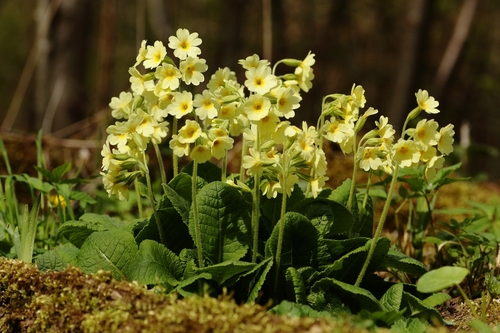
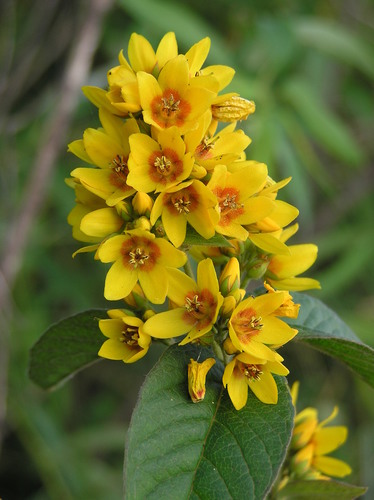
Yellow loosestrife (Lysimachia vulgaris L.) is a tall, downy semi-evergreen perennial herb with an upright growth habit, reaching 50–150 centimetres (20–59 inches) in height. It produces erect panicles of showy yellow flowers. Unlike the related species L. punctata, its petal edges do not have a fringe of hairs. Its hairy, narrow triangular sepals have a distinct orange margin. In the British Isles, it flowers from June to August. Its leaves measure 5–12 centimetres long, have smooth uncut margins, grow opposite one another or in whorls of 3 to 4, are shaped ovate to lanceolate, and are marked with translucent orange glands. Its downy stem can be round or square in cross-section, and is typically solid and filled with pith. Lysimachia vulgaris is native to Eurasia, ranging as far west as Ireland where it is frequent to locally common, and also to North Africa. It was introduced to North America as an ornamental garden plant, where it classed as an exotic introduced species. It grows best in moist habitats including fens, wet woodlands, lakesides and riverbanks. Like many other species in its genus, L. vulgaris is an important nectar source for specialist solitary bees of the genus Macropis, especially Macropis europaea. This relationship between Lysimachia and Macropis is not considered obligate for the plant. In 2004, the plant pathogen Ramularia lysimachiae Thün was first recorded on this species in County Durham. Due to its invasiveness, L. vulgaris is listed as a noxious weed in the US states of Washington and Oregon. While stored soil seeds only have a maximum viability of 3 years, this plant can spread over large areas via vegetative growth from rhizomes, sometimes harming native species. It can stay in a purely vegetative state for several years before blooming, meaning flowering stands confirm the species has been present at the site for a long time. Because it contains toxic compounds, L. vulgaris is unpalatable and avoided by large herbivores. Like other species in the genus Lysimachia, yellow loosestrife has historically been valued for its medicinal properties, and is still sometimes used in traditional folk medicine by some eastern cultures. It has been used as an effective anti-inflammatory, and to treat fever, wounds, ulcers, and diarrhoea. It also has analgesic, astringent, and expectorant effects.