About Lysimachia foemina (Mill.) U.Manns & Anderb.
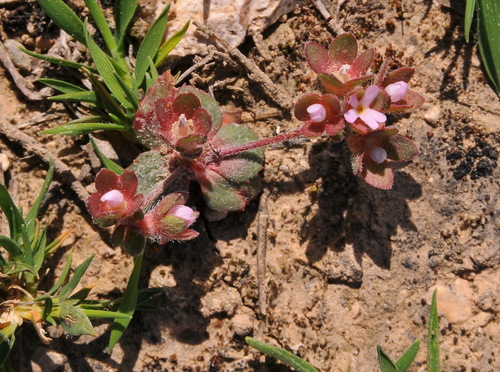
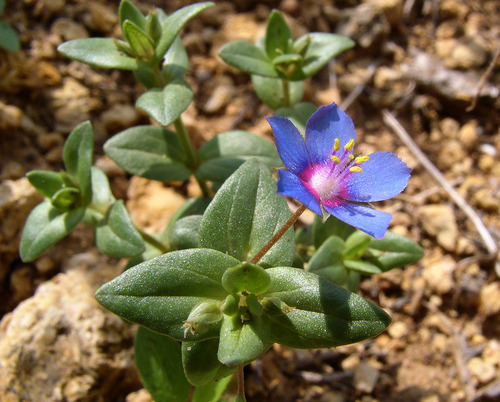
Lysimachia foemina (Mill.) U.Manns & Anderb. has weak, square, sprawling stems that grow 5 to 18 centimeters (2.0 to 7.1 inches) long. Its bright green sessile leaves grow in opposite pairs. Most leaves are lance-shaped, measuring 7 to 11 millimeters (0.28 to 0.43 inches) wide and 12 to 16 millimeters (0.47 to 0.63 inches) long, though some leaves, particularly the lowest ones, may be ovate. The small flowers are around 8 millimeters (0.31 inches) in diameter, have short stalks, grow from leaf axils, and are typically blue. Flowers have five lanceolate sepals and five petals. Filaments measure around 3 millimeters (0.12 inches) long, with noticeable yellow anthers. Flowering occurs from April to October. The hermaphroditic flowers are pollinated by insects, a process called entomogamy. The fruit is a spherical capsule up to 4 millimeters (0.16 inches) in diameter that holds approximately 15 seeds.
This species is very similar to the related Lysimachia arvensis, and was previously treated as a subspecies of L. arvensis. A 2007 molecular phylogenetic study found that Lysimachia foemina is more closely related to Lysimachia monelli than to Lysimachia arvensis, so it is now classified as a separate species.
This cosmopolitan species is native to central and southern Europe, and has been introduced to Africa, northern and eastern Asia, North and South America, and western Australia. It grows in scrub, uncultivated soils, and grasslands. It favors dry, nutrient-rich, lime-rich soils, growing at altitudes between 0 and 1,200 meters (0 to 3,937 feet) above sea level.