About Lysimachia europaea (L.) U.Manns & Anderb.
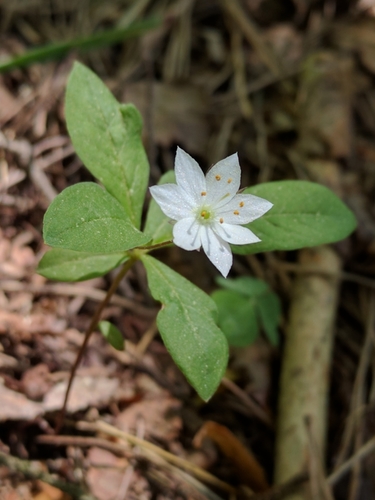
Lysimachia europaea (formerly classified as Trientalis europaea) is a flowering plant belonging to the primrose family Primulaceae. Its common names are chickweed-wintergreen and arctic starflower. This is a small herbaceous perennial plant that grows one or more whorls of leaves on a single slender, erect stem. It reaches around 10 cm (3.9 inches) in height. Its broad lanceolate leaves are pale green, and develop a copper color in late summer. Solitary white flowers, 1–2 cm (0.39–0.79 inches) in diameter and usually bearing 6–8 petals, resemble small wood anemones and bloom in midsummer. Its fruits are globular dry capsules, which are rarely produced. Lysimachia europaea grows across the boreal regions of Europe and Asia. It is not present in eastern North America, where Lysimachia borealis largely replaces it in matching habitats. It is a woodland indicator species. In Scotland, it grows on acid, organic soils, most commonly in pine, birch, and oak woodland, moorland that previously supported woodland, and occasionally on heaths. The plant competes well with other vegetation, rarely reproduces by seed, and is a poor colonizer. It forms large clonal populations connected by rhizomes during the growing season. Both rhizomes and above-ground growth are deciduous; the plant produces overwintering tubers to survive cold months. The species' range in Scotland is changing very little, but it has declined in northern England due to woodland clearance and moor burning. Despite this decline, its exact distribution on the North York Moors is now better documented. This flower is the provincial flower of Värmland province in Sweden, and the county flower of Nairn. Trientalis europaea is still widely referenced in botanical literature under the updated name Lysimachia europaea.