About Lysimachia clethroides Duby
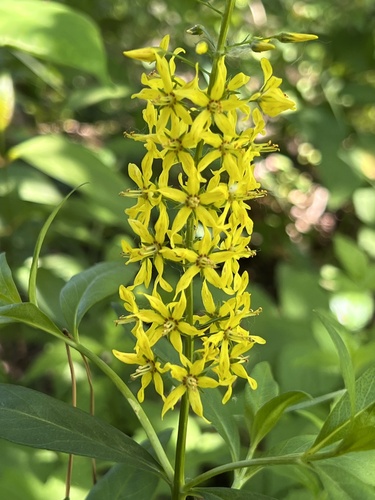
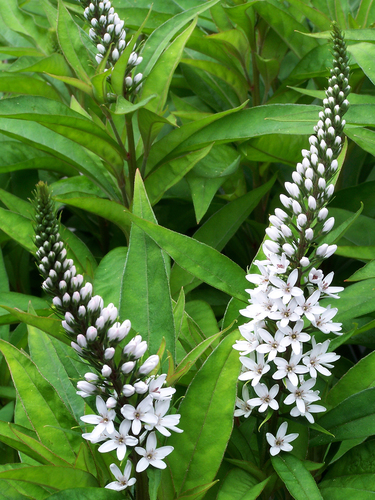
Lysimachia clethroides Duby is a hardy herbaceous perennial plant that grows to heights of 60–100 cm (24–39 in), and resembles a tall speedwell. It has an upright, rigid stem. Its leaves are scattered and alternate, shaped oblong or broadly lanceolate, measuring about 5 cm wide and 7 to 11 cm long, with smooth entire margins. Tiny snow-white flowers, each 1.2 cm wide with five petals, grow in terminal spikes. The bent inflorescence has a sparsely haired axis and reaches 22 to 24 cm in length. This species blooms throughout summer, forms underground stolons, and acts as a pioneer plant in its natural range. The specific epithet clethroides means "like alder" (Clethra).
This plant is native to China and Japan, and is also found in Russia, Korea, and North America. It grows in damp woodland margins, wet ravines, forests, sunny grassy hills, and mountain slopes, at elevations between 300–2,100 m (980–6,890 ft) above sea level. It prefers deep, rich loam and sheltered positions, and has been awarded the Royal Horticultural Society's Award of Garden Merit.
In China, most commonly in the Chaoshan region, leaves of Lysimachia clethroides are used as a leaf vegetable in cuisine, for making salads, stir-fried dishes, or soups. These leafy greens are called pearl vegetable, and are low in sodium and high in potassium. In traditional medicine, Lysimachia clethroides is known by many common names: dwarf peach, pearl grass, regulating grass, the ridge grass, ji cocktail, labor injury medicine, stretch lotion, and nine lotus. It is used to treat diarrhea, bruises, sore throat, heat exhaustion, and edema.