About Lysimachia asperulifolia Poir.
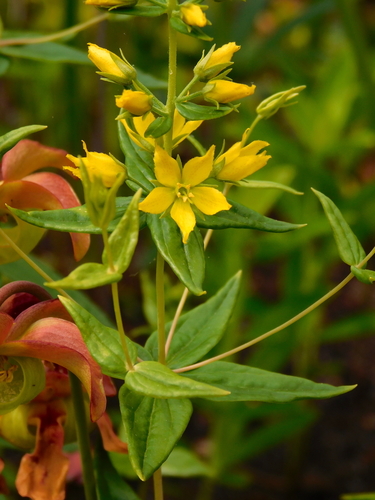
Lysimachia asperulifolia Poir. is a rhizomatous perennial herb that grows erect, reaching a maximum height of 60 to 70 centimeters. The lower section of its stem is pinkish and ribbed, while the upper stem is yellowish and smooth with no ribs. The stem portion that holds the inflorescence is covered in reddish glands. Its leaves are green, lance-shaped, and grow up to 5 centimeters long and 2 centimeters wide. Leaves are typically arranged in whorls of three or four around the stem, and sometimes grow in opposite pairs. Contrary to what the species' common name suggests, its leaves do not have a rough texture. Near the base of the stem, smaller, tougher brown-colored leaves grow either opposite or in whorls of up to 7 leaves. The top of the stem holds the inflorescence, which is a raceme of star-shaped yellow flowers interspersed with leaf-like green bracts. Each flower has 4 to 7 petals, most commonly five, which are yellow with wide bases and pointed, ragged tips. Both the petals and green sepals are dotted with red glands and streaked with reddish resin canals. The fruit this plant produces is a straw-colored capsule mottled with red, measuring a few millimeters in length.
This herb grows in multiple plant communities across the coastal plains of southern North Carolina and northern South Carolina. It can be found in pocosins, sandhills, pine flatwoods, and pine savannas, and is most common in open areas of the ecotone between longleaf pine uplands and pond pine pocosins. Its habitat has soil that is seasonally wet to waterlogged or submerged, low in nutrients, and formed of peat-rich layers over sandy substrates. In pristine natural conditions, this plant grows in openings within a dense shrub layer that are kept open by severe periodic wildfires. Fire prevents ecological succession, keeping taller vegetation small and sparse so that the herb layer can flourish in sunlight. Associated woody plants and ferns in its habitat include Aronia arbutifolia (chokeberry), Clethra alnifolia (summersweet), Cyrilla racemiflora (titi), Fothergilla gardenii (dwarf fothergilla), Ilex glabra (Appalachian tea), Magnolia virginiana (sweetbay), Osmunda cinnamomea (cinnamon fern), Persea palustris (swampbay), Symplocos tinctoria (yellowwood), and multiple Vaccinium species (wild blueberries). Associated herbs, grasses, and mosses include Andropogon glomeratus (bushy bluestem), Aristida stricta (wiregrass), Drosera intermedia (oblong-leaved sundew), Drosera capillaris (pink sundew), Lachnanthes caroliniana (redroot), Peltandra sagittifolia (spoon flower), Sarracenia flava (yellow pitcher plant), and multiple Sphagnum species (sphagnum mosses).
In the 1980s, the only known viable populations of the plant were located in Green Swamp Nature Preserve, Croatan National Forest, Military Ocean Terminal Sunny Point, and Fort Bragg. A prescribed fire program was implemented on regional military base lands to preserve habitat for the red-cockaded woodpecker (Picoides borealis). This fire-managed habitat was also suitable for Lysimachia asperulifolia, so new additional populations emerged in areas where the species had previously been crowded out by vegetation overgrowth. One new population is located at Camp Lejeune, and additional populations grew at Fort Bragg. The South Carolina population is located on Fort Jackson. By 1995, 64 total populations were known. The species usually reproduces vegetatively by sprouting new stems from its rhizome to create clones, so what appears to be a large population may actually consist of relatively few genetically distinct individuals, with many cloned stems growing above ground.