About Lysichiton americanus Hultén & H.St.John
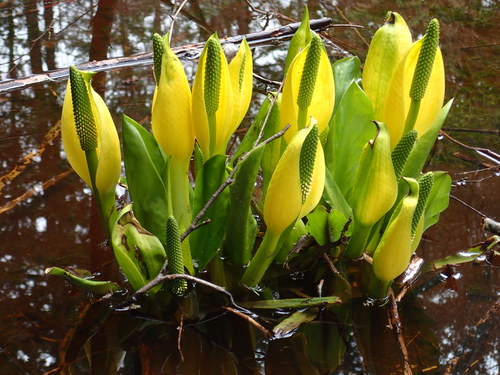
Lysichiton americanus Hultén & H.St.John grows from rhizomes that are 30 centimeters (12 inches) or longer, with a diameter of 2.5 to 5 cm (1 to 2 in). When mature, its short-stalked leaves are the largest of any native plant in its native region, reaching 30–150 cm (12–59 in) in length and 10–70 cm (4–27+1⁄2 in) in width. The species produces flowers on a spadix, which is enclosed in a large 7–12 cm (3–4+1⁄2 in) bright yellow or yellowish green spathe that sits atop a 30–50 cm (12–20 in) stalk. Its numerous flowers are densely packed, and it is among the first plants to bloom in late winter or early spring, with a typical blooming period of March to July. Unlike species in the genus Symplocarpus, which includes S. foetidus (eastern skunk cabbage), Lysichiton species do not produce heat when flowering, even though this is a common incorrect claim.
In its native range, Lysichiton americanus occurs from Kodiak Island and Cook Inlet, Alaska, south through British Columbia, Washington, Oregon, and Northern California as far south as Santa Cruz County. Isolated native populations are also found in northeastern Washington, northern Idaho, Montana, and Wyoming. The plant was introduced to cultivation in the United Kingdom in 1901, and has escaped cultivation to become naturalized in marshy areas across Britain and Ireland. Naturalized populations have been recorded in locations including Hampshire, Surrey (including Wisley Gardens), as well as northern and western parts of the UK. Once this species becomes established in an area, it is very difficult to control. In 2016, the European Union classified Lysichiton americanus as an invasive species. This classification bans the import, cultivation, transport, commercialization, planting, or intentional release of the species into the environment across the entire European Union.
In its ecology, flies are attracted to the plant's odor to pollinate its flowers. While some people categorize this plant as a weed, deer may browse its leaves, and its roots serve as food for American black bears. After emerging from hibernation, bears eat this plant to use it as a laxative or cathartic.
Lysichiton americanus contains calcium oxalate crystals. Consumption causes a prickling sensation on the tongue and throat, and can lead to intestinal irritation; consumption of large quantities can even cause death.
The species was grown as an ornamental garden plant in Britain and Ireland, where it grows well in marshy growing conditions. As of 2018, the Royal Horticultural Society recommends that it should not be cultivated. Hybrids between Lysichiton americanus and Lysichiton camtschatcensis, named Lysichiton × hortensis, are also cultivated, and these hybrids produce larger spathes than either of their parent species.
Indigenous peoples used this plant for medicinal purposes to treat burns and injuries, and as an emergency food source during times of famine, when leaves were heated before eating. The leaves have a somewhat spicy or peppery taste. Though the plant was not part of a typical human diet under normal conditions, its large, waxy leaves were important for food preparation and storage. They were commonly used to line berry baskets, and to wrap whole salmon and other foods for baking under a fire. Leaves were also used as medicated bandages to treat sores and swelling, and the plant's sap was used as a treatment for ringworm.