About Lysiana exocarpi (Behr) Tiegh.
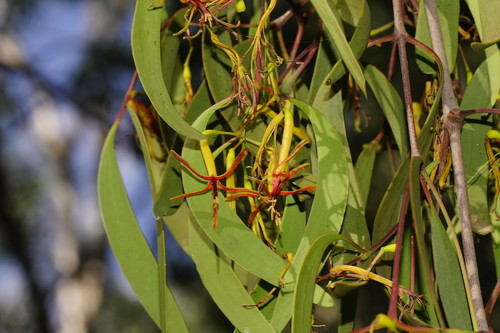
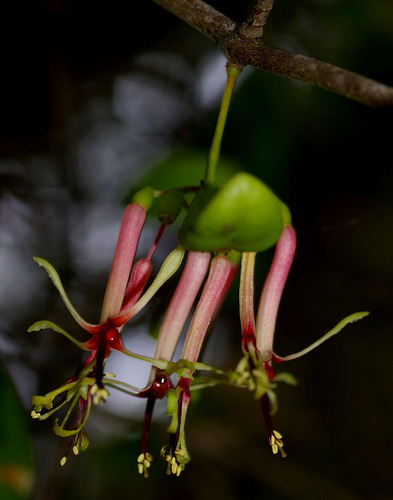
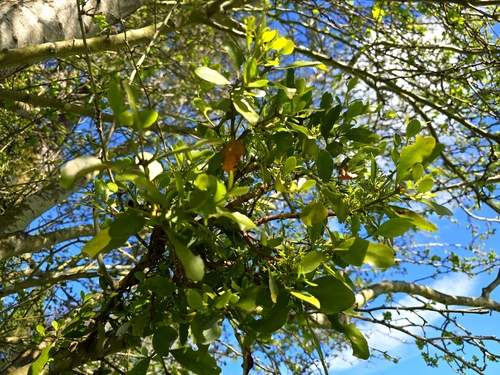
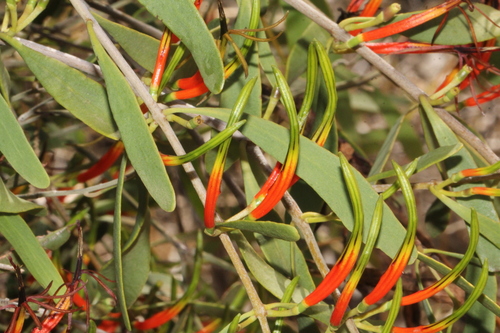
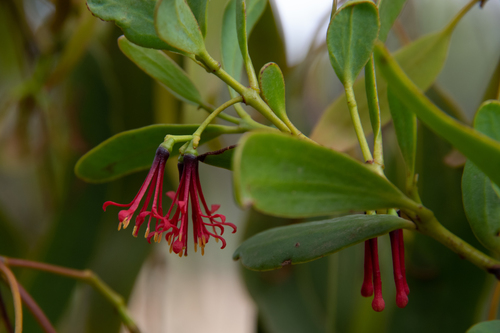
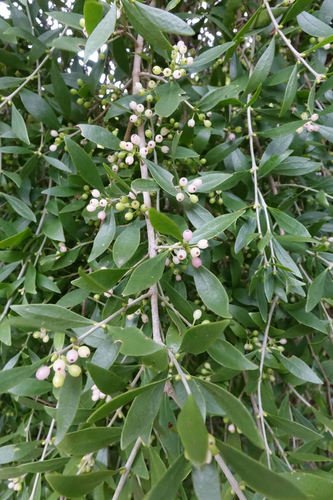
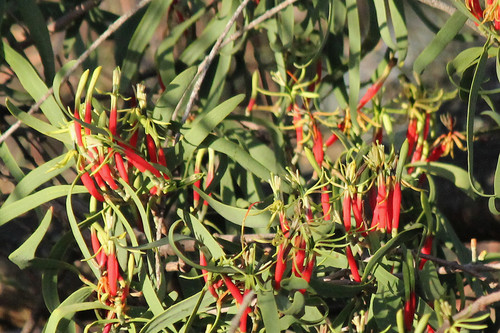
Lysiana exocarpi (Behr) Tiegh. is a glabrous spreading plant that grows as a shrub, and produces no external runners. Its leaves are either flat or compressed when very narrow, and range in shape from linear to narrow-oblong. Leaves are either sessile, or shortly petiolate when wider, and measure 3–15 cm long and 1–10 mm wide. The leaf apex is usually rounded, the leaf base is attenuate and contracted, and leaf venation is obscure. Inflorescences are pedunculate and usually take the form of a 2-flowered umbel. The peduncle is usually 0.5–2 mm long, pedicels are 2–5 mm long, and bracts are 1–1.5 mm long. The corolla is 25–50 mm long, usually red, and rarely yellow; it may also be tipped with green or black. The fruit is ellipsoidal to ovoid, 6–10 mm long, and either red or black. Lysiana species can be broadly grouped into two groups: those with 80-90 units of DNA, and those with greater than 100 units of DNA. L. exocarpi is the only species in the genus that extends its range into temperate non-arid regions, and its DNA values are predominantly above 100, with an average of 117 units. It grows in open woodland and forest, and extends into semi-arid woodlands dominated by acacia. The full species occurs in arid and temperate regions of all Australian mainland states, ranging from Lake Carnegie, Western Australia, to the Hunter Valley, New South Wales. It grows in open forest and woodland on many different host plants, but is frequently found growing on other Loranthaceae. Lysiana exocarpi subsp. exocarpi occurs in arid and temperate Australia from Lake Carnegie to western Queensland and central Victoria. It grows on many host species, most frequently on Acacia, Amyema, Cassia, Casuarinaceae, Eremophila, Exocarpos, Alectryon and exotic trees. This is a polymorphic subspecies, with a cline towards wider and thicker leaves moving from temperate to arid habitats. Lysiana exocarpi subsp. tenuis occurs in Queensland and New South Wales from the Darling Downs to the Hunter Valley and inland to the Western Plains. It grows in open woodland and forest, usually on Casuarinaceae. In Europe, mistletoe leaves and young twigs are used by herbalists, especially in Germany, to treat circulatory and respiratory system problems. Mistletoe extract is sold under the trade names Iscador, Helixor, and several others. The use of mistletoe extract to treat cancer originated with Rudolf Steiner, founder of Anthroposophy, who compared the parasitic nature of mistletoe to the nature of cancer, and believed that cancer represents a faltering of the body's spiritual defenses. Public interest in mistletoe extract for cancer treatment in the United States was spurred in 2001 after actress Suzanne Somers chose to use Iscador instead of chemotherapy following her breast cancer treatment. However, available clinical evidence does not support claims of anti-cancer effects, improved quality of life, or any other positive outcomes from the use of mistletoe extract. In 2007, researchers from Griffith University in Queensland found that a new natural product called lysianadioic acid, isolated from Lysiana subfalcata, a species in the same genus as L. exocarpi, was a carboxypeptidase B (CPB) inhibitor. It is a potent inhibitor of CPB, with an IC50 of 0.36 μM, and this is the first known example of a small molecule CPB inhibitor isolated from plant origin.