About Lysandra coridon (Poda, 1761)
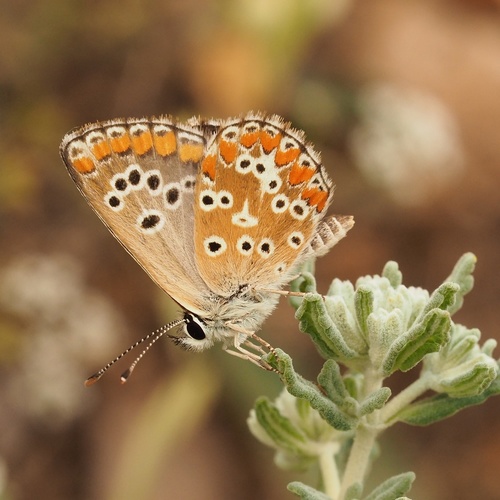
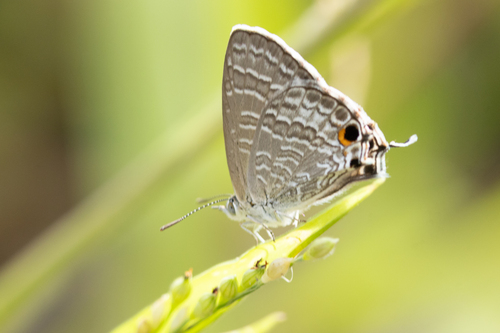
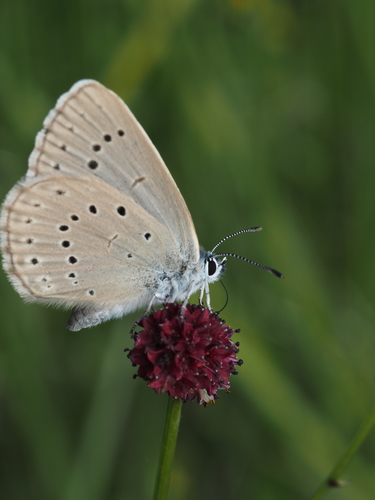
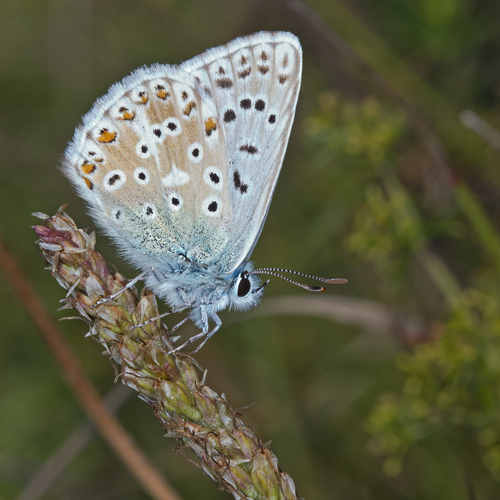
Lysandra coridon (Poda, 1761) is a small butterfly with a wingspan of 30–36 millimetres (1.2–1.4 in). This species exhibits clear sexual dimorphism. Males have pale silvery-blue wing uppersides, a submarginal line of grey spots on the hindwings, and a thin brown and white chequered fringe. Females have dark brown wing uppersides, marginal orange spots, and chequered fringes matching the males. The underside of the wings is light ochre, with several dark spots surrounded by white, a submarginal line of black marks, a row of marginal orange spots on the hindwings, and blue dusting near the body. Like many blue butterflies, this species is distinguished from similar species in the field by its underside markings, and aberrations are very common. A description from Seitz notes: L. coridon Poda (81 c, d). Males have a light blue-green upperside with a silvery glitter, a broad black margin on the forewing, and dark dots at the margin of the hindwing. The underside is light violet-grey on the forewing and brownish on the hindwing, variegated with white, bearing yellowish red submarginal spots, and both wings are very densely covered in ocelli. Females have a russet grey-brown upperside, an earth-brown underside, and like males have very numerous ocelli. This species’ distribution area is essentially smaller than most other Blues, and is apparently entirely restricted to Central and South Europe. It occurs from England, Pomerania, and St. Petersburg southwards to Spain, Italy and Brussa, and from the Pyrenees to Orenburg. Even though the species is very uniformly developed, quite a number of named forms have been described, many based on very minute differences. Variation in the upperside includes multiple forms. hispana H.-Schiff. (= arragonensis Gerh.), now classified as Lysandra hispana (Herrich-Schäffer, [1851]) from Spain, is paler with stronger spotting on the distal margin. apennina, now Lysandra apennina (Zeller, 1847) (81 d), is overall paler; the dark marginal border of the forewing is lighter due to an intermixture of the ground colour, and it is found in Italy. The Greek form graeca Ruhl-Heine is quite similar to apennina. rezniceki Bartel, now classified as L. hispana var. rezniceki Bartel, 1904 from Northern Italy, is a transition to apennina; males have an even paler upperside according to descriptions. albicans H.-Schaff., now Lysandra albicans (Gerhard, 1851) (81 d), is the lightest form, with an almost white upperside; it flies on limestone in Spain, sometimes occurring as the only form, and sometimes alongside hispana (Ribbe). caucasica Led. (= ossmar Gerh.), now Lysandra caucasica (Lederer, 1870) (81 e), extends into the Asian continent, flying in Armenia and at the Black Sea. Males have a brighter blue upperside. Specimens from the Taurus Mountains have a slight violet sheen, especially in the outer area of the wings; this form is corydonius H.-Schaff. (= olympica Led.) (81 d), now classified as Lysandra caucasica (Lederer, 1870). Occasional blue colour can appear on female uppersides: it may be restricted to the base (ab. semibrunnea Mill. (=semi-syngrapha Tutt)), or may cover the entire upperside (ab. syngrapha Kef. (= mariscolore Gerh.) (81 d)). On the other hand, the blue upperside of males can be dulled by a grey suffusion: ab. suffusa Tutt. Other accidental forms include males with red spots on the upper margin: ab. suavis Schultz, and females with these spots: ab. aurantia Tutt. In ab. inaequalis Tutt, glossy blue colour forms irregular streaks on a dark ground. In ab. marginata Tutt, the black margin is broadened. In ab. fowleri South, the margin is white instead of black, while in ab. punctata Tutt the margins are spotted. ab. calydonius Lowe has darkened ground colour and enlarged black borders. The underside is just as variable as the upperside. The underside ground colour can be very dark (especially in certain females) or remarkably pale; the pale form is ab. pallida Tutt. Ocelli may be distorted into rays: ab. striata Tutt. Some ocelli may be joined together: ab. tiphys Esp. Ocelli may be increased in number: ab. luxurians Courv., or they may be reduced (ab. privata, unipuncta, impuncta) or entirely absent: ab. cinnus Hbn. (= sohni Ruhl) (81 d). Additionally, all these variations may be more or less slightly developed or vestigial (e.g. ab. semiaurantia, caeruleomarginata), or multiple aberrational traits may be combined in a single individual, for example ab. parisiensis Gerh., which is an ab. syngrapha with ocelli matching those of ab. tiphys. Eggs are greenish white, with fine pale hexagonal reticulation. Larvae are bright blue-green, paler below; the dorsal line appears dark from the dorsal vessel, and is accompanied by chains of yellow spots, with a similar but duller row of spots above the abdominal legs. Larvae develop until June on plants of genera Hippocrepis, Coronilla, Astragalus, Vicia, and others. They are visited by Formica flava, which is attracted to their dorsal gland. Pupae are rather slender, smooth, dirty yellowish brown, with a dark dorsal line and pale smears on the wing cases; they are free on the ground, often under stones. Adult butterflies fly from June until August; they are rare in some locations and exceedingly abundant in others, and only occur in specific localities. They have a rapid, more sustained flight than most other Blues, and go to rest early, settling for the night with closed wings on grass stalks or flower tops while it is still full daylight. This behaviour creates good collecting opportunities for aberrations, as the underside ocelli are clearly visible, so desired specimens can be easily selected and collected. This species is found in the Palearctic realm: across western, southern, and central Europe, Asia Minor, the south Urals, and northwest Turan. Its range spans Central Europe, and it is endemic to Europe. It is absent from Ireland, Scotland, Scandinavia, the Netherlands, most of the Iberian Peninsula (only found in its northern provinces), most Mediterranean islands (it occurs in Corsica and Sardinia), and most of southern Italy. This butterfly prefers dry calcareous grasslands at elevations of 100–2,000 metres (330–6,560 ft) above sea level, and also favours short grasslands with abundant flowering plants. L. coridon is a sedentary species, meaning it does not travel far within its habitat range, and individuals tend to stay within their habitat patch rather than undertaking long migrations to new habitats. Habitat fragmentation is a process where environmental features separate populations of the same species. Mountain ranges separate the west and east populations of L. coridon; this separation changes allele frequency in both populations, and the populations can only mix where their habitat remains connected. Habitat loss is another cause of fragmentation, driven by human interaction with ecosystems that isolates L. coridon populations. Habitat loss changes the number of individuals an area can support and cuts populations off from the wider species network. Small population size and isolation reduce population genetic heterogeneity and lead to lower fitness. Habitat fragmentation makes conservation efforts difficult, as planners must select areas for protection that are most likely to increase population size without damaging overall population fitness, so great care is taken when selecting protected areas.