About Lysandra bellargus (von Rottemburg, 1775)
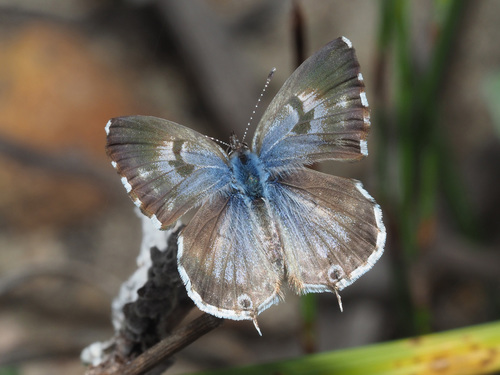
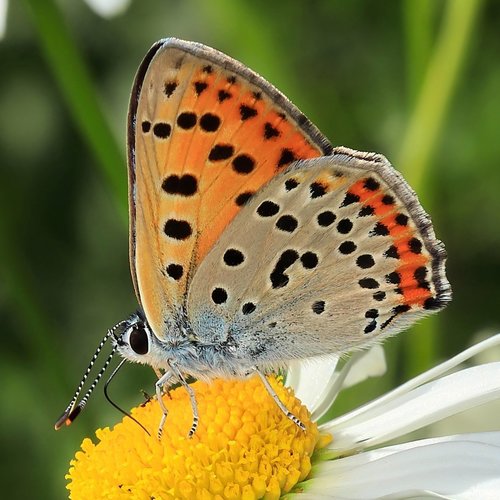
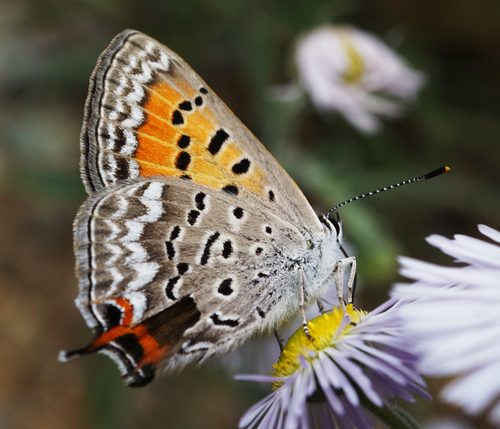
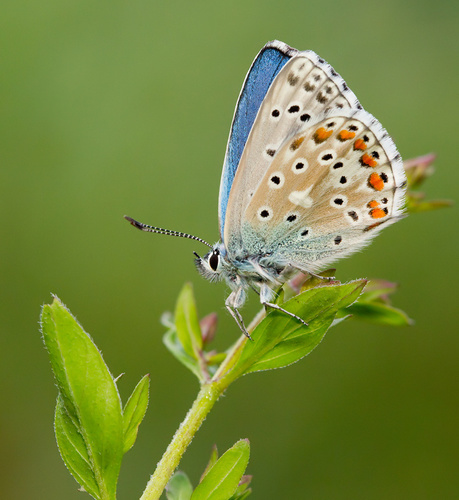
This species is scientifically known as Lysandra bellargus (von Rottemburg, 1775), commonly called the Adonis blue. Males have brilliant sky-blue upper wing surfaces, with a fine black line along the edge and a white margin. Females have chocolate brown upper wings, with a small number of blue scales near the wing base; orange spots bordered by blue scales run around the edge of the hindwing. Both sexes have chequered wing fringes. The wing underside is brownish grey, marked with black and orange crescent spots. The species has a wingspan of approximately 3 cm (1.2 in). Fully grown caterpillars reach 1.6 centimetres (0.63 in) in length, with a dark green body, dark spines, and yellow bands along the back and sides. In Seitz's description, L. bellargus Rott. matches the size of L. icarus. Males have very light, glittering sky-blue upper wings, while females have dark brown upper wings, a red submarginal band, and a black discocellular spot on the forewing. The underside resembles that of L. coridon: the rings surrounding the ocelli are large, and contrast conspicuously with the brown ground color, which is particularly dark in females. This species is found across Central and Southern Europe, as well as Anterior Asia extending as far as Kurdistan. Multiple aberrations of the upper wing color and pattern are described. Ab. adonis Hbn. is very light blue and strongly glossy. Ab. pallida Tutt is duller and more lilac than typical bellargus. Ab. suffusa Tutt (= czekelii Aign.) has suffused blue shaded plumbeous, which reduces the brightness of the blue color. Ab. ceronus Esp. refers to females with upper surfaces strongly dusted with blue. Lysandra × polonus (Zeller, 1845) (polonus Z.) is only found in specific districts of East Prussia, Russia, Syria, and Spain; its light blue color is shaded silvery, the black border is somewhat broader, and the hindwing bears dark dots at the outer margin. Ab. latefasciata Schultz describes females with an unusually broad red submarginal band on the upper surface. A form from Algeria, now recognized as a full species called punctifera Oberth., has a magnificent glossy blue upper surface, is usually somewhat larger than Central European specimens, and has distinct black spots before the distal margin of the upper hindwing. Occasional European specimens show traces of submarginal dots on the upper hindwing without the other characteristics of punctifera; this form is named ab. parvipuncta by Aigner-Abafi. If similar dots appear on the forewing, the form is called ab. puncta Tutt. Underside ocelli can also vary: they may enlarge enough that some become confluent (forms confluens Aign., striata Tutt), or they may disappear entirely (ab. krodeli Gillm. (= cinnides Stgr., adonis Hbn. pt.)). Ab. sapphirus Meig. describes specimens where only the usually present basal ocelli of the forewing are absent. Eggs are semiglobular, with a slightly impressed top, are pale green, and marked with a white reticulated pattern. Larvae are bright leaf-green, with a dark dorsal stripe accompanied by small orange-yellow spots that form two subdorsal lines, plus similar yellow stripes on the sides, and have a black head. They feed on Hippocrepis and Coronilla, and can be found until April, and again in the summer. Pupae are green or brown, with a dark stripe along the back, and pupate on or close to the ground. Adult butterflies fly in May and June, and again in August; in southern regions, a third brood flies in September and October. They prefer open places, fallow ground, young plantations, and sunny slopes. During the day they rest with their wings open, and sleep with wings tightly closed on umbels, thistles, scabious, and grass stalks. When disturbed, they jump down into the grass. They are common across most of their range in their typical flight areas, and occur in mountains up to 2,100 metres (7,000 ft). The preferred habitat of the Adonis blue is calcareous grasslands with hot, dry conditions, because its larva feeds on horseshoe vetch (Hippocrepis comosa), a plant largely restricted to this habitat type. Horseshoe vetch flourishes on sheep-grazed pastures, and dies out within a few years under cattle grazing. Sometimes human-created landforms act as refuges for the plant and butterfly; an example is Martin Down in Dorset, where horseshoe vetch only grows on ancient earthworks with thin calcareous soils.