About Lymantria serva Fabricius, 1793
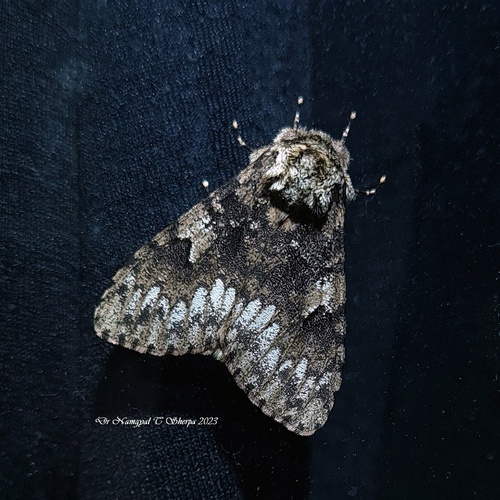
This moth species, Lymantria serva, shows distinct size differences between males and females. Male forewings measure 17–19 mm in length, while female forewings range from 26–36 mm long. Males have a brownish overall body color, and their abdomens carry a slight crimson tinge. Male forewings are sprinkled with dark scales, and feature indistinct double lunulate antemedial, medial, and postmedial lines. A black lunule sits at the end of the forewing cell, with no spot present inside the cell itself. Male hindwings are a pale brownish fuscous color. Females have a fully crimson abdomen, marked with a dark line along the vertex and a series of lateral black spots; the tip of the abdomen is brownish. Female hindwings have a crimson-suffused inner area. The larvae of Lymantria serva feed on Ficus species and Shorea robusta. Larval development is unusually long, going through 10 to 12 instars. Females of this species are known to emit the sex pheromone 2-Methyl-(Z)-7-octadecene, and Lymantria serva is allopatric with Lymantria lucescens.