About Lymantria monacha Linnaeus, 1758
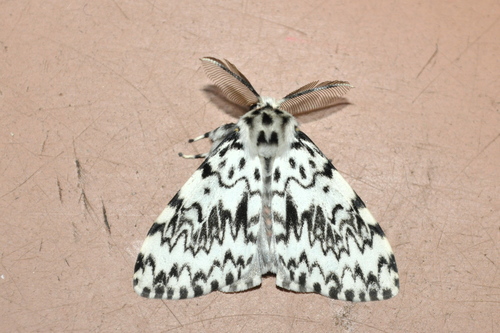
Adult moths of Lymantria monacha have a wingspan ranging from 40 to 50 mm. Their forewings are white, marked with connected black wavy arches, which is the feature that gives the species its common name. Their hindwings are light brown, with white fringes that bear black spots. They also have a characteristic biscuit-colored abdomen marked with a black band. Females are larger than males and have elongated wings. The eggs of this species are oval, and are colored light brown or light red. Larvae range in color from whitish grey to blackish, with grey hairs, red and blue warts, and a dark longitudinal dorsal line that is interrupted or broadened into spots in some areas. The pupa is glossy golden red-brown or dark brown, with reddish hairs on its dorsal side and a rather long anal point. A more detailed technical description and notes on variation note that forewings are white with black basal spots and four sharply angled black transverse lines; the second of these lines is the broadest. Hindwings are a mix of greyish white and grey, and the abdomen is light rosepink. This species varies strongly in appearance, and has multiple named aberrations, all recorded from European specimens. In the aberration nigra Fr., the two central bands join at the costal and posterior margins to form black spots, or the entire median area is dark, and the red coloring of the abdomen is usually weaker. In eremita G., the forewing and abdomen are smoke-brown or blackish grey, with black markings retained on the forewing. In atra Linst., the forewing is uniformly black with no markings, the hindwing is greyish brown, and the abdomen is black. The light form lutea Anel has interrupted central bands, and the red color of the abdomen remains equally deep almost all the way to the thorax. In flavoabdominalis Schultz, the abdomen is yellow rather than red. In the female aberration subfusca Schultz, all regions that are black in typical Lymantria monacha are yellowish brown, and the abdomen is also yellowish brown instead of red. In obsoleta Schultz, the dark transverse bands in the median area of the forewing are absent, though these bands remain in the basal and outer-marginal areas. This moth occurs across most of Europe, including Great Britain, and extends through temperate regions of the Palearctic eastward to Japan and India. Young larvae hibernate, stay grouped together in batches, and reach full growth by June. Larvae feed preferentially on spruce (Picea abies) and pine (Pinus sylvestris). They also feed on silver fir (Abies alba), European larch (Larix decidua), aspen (Populus tremula), hornbeam (Carpinus betulus), European beech (Fagus sylvatica), pedunculate oak (Quercus robur), apple (Malus domestica), sycamore (Acer pseudoplatanus), bilberry (Vaccinium myrtillus) and bogberry (Vaccinium uliginosum). In spring, larvae first consume new buds, then move on to needles later. A single caterpillar eats roughly 200 pine needles or 1000 spruce needles, and twice that number of needles are damaged by being bitten off. Spruce trees die when they lose 70 percent of their needles, while pines die at 90 percent needle loss. Outbreaks also increase the risk of secondary infections from longhorn beetles, bark beetles, fungi, or other pathogens. For these reasons, outbreaks of Lymantria monacha can cause major damage to forestry.