About Lygeum spartum Loefl. ex L.
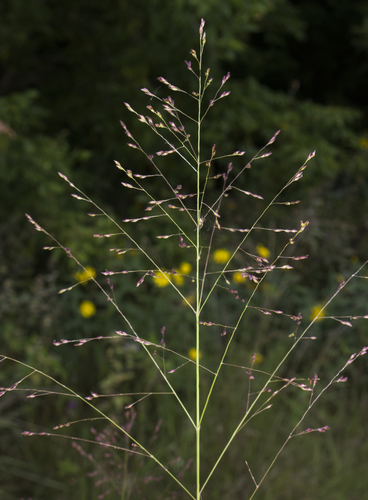
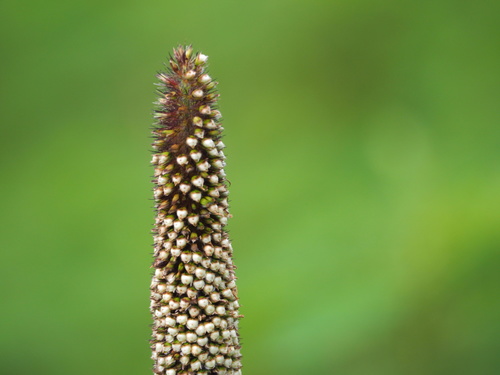
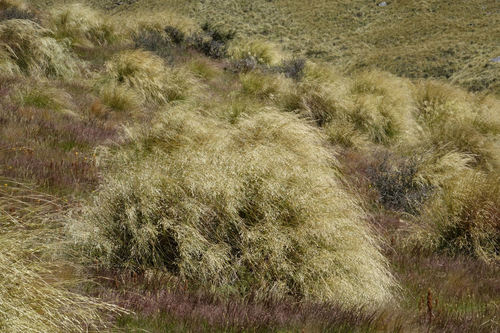
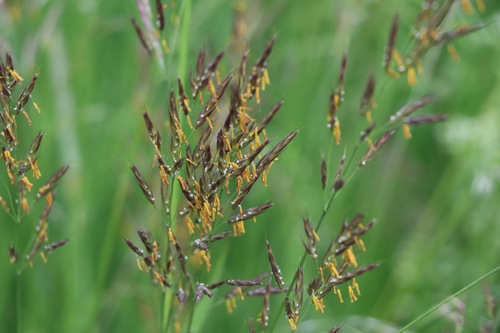
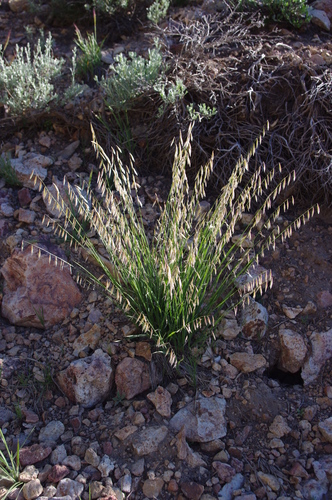
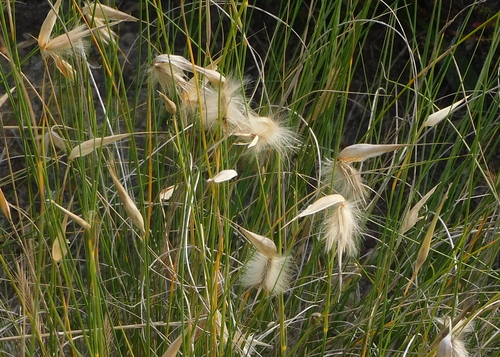
Lygeum spartum Loefl. ex L. is a rhizomatous, hermaphroditic perennial grass that reaches up to 75 centimetres (30 inches) in height. Both its rhizome and the base of its stem are scaly. Its leaves are threadlike, but stiff and tough, and grow up to 50 centimetres (20 inches) long. Its inflorescence consists of a small number of long-haired spikelets, each up to 4.5 centimetres (1+3⁄4 inches) long. Each spikelet is wrapped in a lance-shaped bract called a spatheole; this sheath is 3 to 9 centimetres (1+1⁄6 to 3+7⁄12 inches) long, and may have a sharp point. This species is native to southern Europe and North Africa, where it occurs in Crete, Italy, Spain, Algeria, Egypt, Libya, Morocco, and Tunisia. It may have been introduced to Kashmir. It grows in rocky sea shore habitats, and on dry sandy, clay, and often calcareous soil. The fibres of Lygeum spartum have high tensile strength and flexibility, so they are used to make ropes, sandals, baskets, mats, and other durable articles. They have also been used to manufacture high quality paper. Locally, the plant can be used as livestock fodder. It is also used to stabilize sand dunes and rehabilitate salt-affected soils, because it tolerates saline conditions.