About Lygephila pastinum Treitschke, 1826
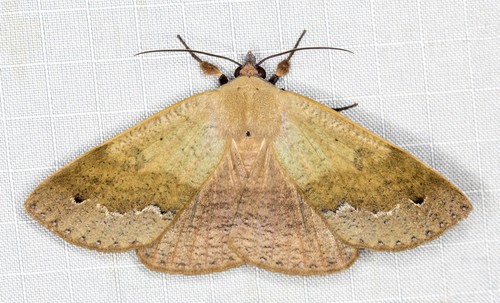
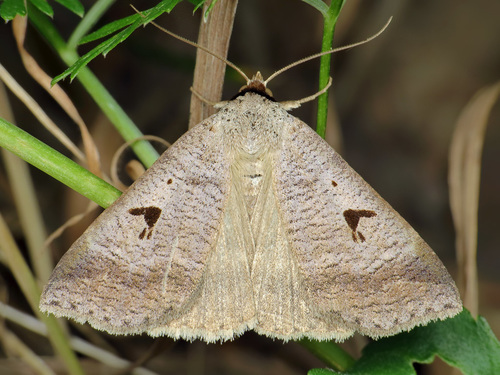
This is a technical description and variation account for Lygephila pastinum Treitschke, 1826 (also referenced as O. pastinum Tr. = lusoria Hbn. nec L.). The forewing is pale luteous grey, covered with dark wavy vermiculations; the costa and terminal area are brownish grey. The inner line is outwardly curved, greyish brown, and often obscure. The outer line is dark, pale-edged, outcurved above, and indented on the submedian fold, followed by a diffuse dark shade. The subterminal line is barely distinct. The orbicular stigma is a single black dot; the reniform stigma is a black lunule, with its lower end extended outwards and followed by two black points. The hindwing is pale brownish grey, with an indistinct outer pale line. Two named geographic forms are recorded: the form astragali Rmb., from Spain, has forewings more densely covered with dark striae, where the terminal spots are barely visible; by contrast, dilutior Stgr., from the Kentei Mts., has paler, less distinctly marked forewings. The aberration decolor ab. nov. (68 f) is much paler than the typical form and lacks any brown tinge; nearly 20 specimens of this form were collected in July and August between 1901 and 1903 at Tarasp in the Engadine by Mr. Rothschild and Mr. Haktert, and it may be identical to the ab. dilutior Stgr. from Kentei. The larva is pale yellowish grey, dotted with black, with a row of yellow spots along the middle of the back and a row of small yellow spots on each side of the back. Laterally, it has a broad white grey-mottled black-dotted stripe positioned above, and an orange stripe dotted with white edged below with yellow beneath that; it also has a black stripe above the prolegs. The wingspan of the adult moth is 37–42 mm, and the forewing length is 18–21 mm.