About Lygephila craccae (Denis & Schiffermüller), 1775
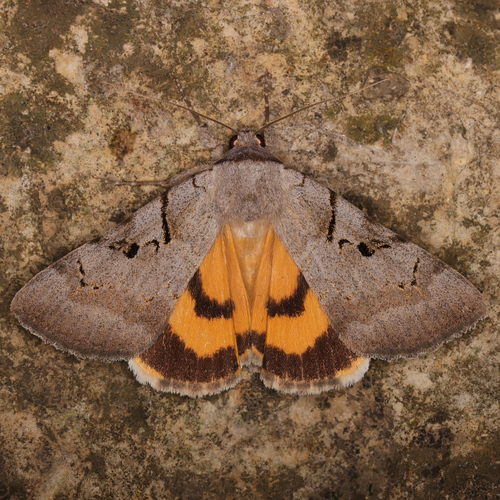
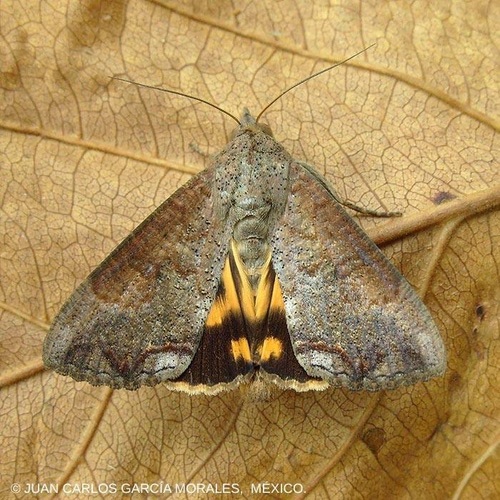
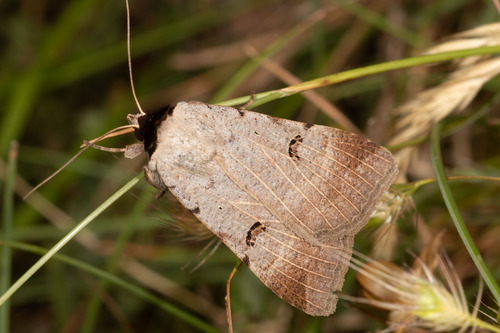
Scientific name: Lygephila craccae (Denis & Schiffermüller), 1775. This species is larger than Lygephila viciae. Its forewings are darker grey with a slaty violet tint, marked with darker striations and dusted with darker pigment; veins are pale, costal spots are blackish, and all lines are very faint except the paler subterminal line, which is often only visible due to the darker shade that precedes it. Hindwings are paler, sometimes with a yellowish tint, and have a smoky fuscous terminal border.
The aberration ab. immaculata Stgr. is similar to caecula Stgr., an aberration of L. viciae. It lacks black edging on the reniform stigma, and its costal spots are paler. Subspecies laevigata Warren, from South Tyrol, is a large subspecies with uniformly slate-coloured forewings that have no darker dusting or striation. Subspecies grisea Warren, described from a female specimen collected at Uralsk and received from M. Bartel, has prominently black costal spots on the forewing, with distinct dark fuscous inner and outer lines. The space between these lines and the terminal area are both dark grey, which contrasts strongly with the paler basal area and the pale outward edging of the outer line. The reniform stigma has a fine black inner edge, is filled with the dark grey of the median area, and its outer edge is marked only by two or three black points. Pale veins stand out distinctly against the dark grey suffusion; the hindwing is entirely dark fuscous. This specimen is only the size of an average L. viciae, and may be a separate species.
Two additional forms are here given named classifications. Aberration ab. brunnea ab. nov. has a brown ground colour instead of the typical grey, and sometimes has a rufous tint. Subspecies lutosa Warren, from the South of France, has luteous grey forewings and luteous ochreous hindwings.
The larva is pale yellowish grey, with a broad grey-brown dorsal stripe divided by a fine dark brown line that has pale edges. Segments 5, 6, 7, and 10 have an oblique blackish streak on their sides; segment 12 bears a triangular yellowish-white blotch. There is brown shading below the spiracles.