About Lycoris radiata (L'Hér.) Herb.
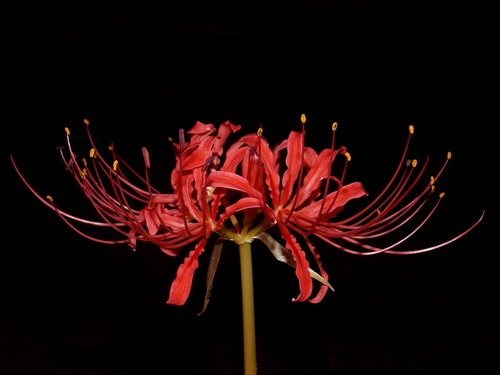
Lycoris radiata (L'Hér.) Herb. is a bulbous perennial plant with showy, bright-red flowers. When fully bloomed, spindly stamens, which are often compared to spider legs, extend slightly upward and outward from the center of the flower. The plant's flowers typically emerge from late August to early September, before its leaves fully develop, growing on scapes that rise 30–70 centimetres (12–28 in) from the ground. Each stalk supports an umbel containing four to six 2-inch long flowers. Individual flowers are irregular, with narrow segments that curve backwards. The leaves, which usually emerge in October, are greyish-green, parallel-sided, 0.5–1 cm (1⁄4–3⁄8 in) wide, and have a paler central stripe. The plant keeps its leaves through the winter, and starts to lose them as temperatures warm in late spring. Like all species in the genus Lycoris, the bulbs of Lycoris radiata are poisonous, primarily because they contain the toxic alkaloid lycorine. If the bulbs are ingested, they can cause diarrhea, vomiting, convulsions, and even death in severe cases. L. radiata also contains the alkaloid galantamine, which has been approved by the United States Food and Drug Administration (FDA) for the treatment of Alzheimer's disease. This plant is cultivated in China for galantamine extraction. All plants in the amaryllis family contain varying amounts of naturally occurring galantamine; the compound can be extracted in trace amounts from the leaves and roots of L. radiata, but is most concentrated in the bulbs. Preliminary studies have found that L. radiata shows potential cytotoxic effects on cancer cells, though further research is needed. All Lycoris species, including L. radiata, are native to East Asia. The plant was first introduced to the United States in 1854 after the signing of the Treaty of Kanagawa, a peace treaty between the United States and Japan that opened Japanese ports to U.S. trade. It is reported that Captain William Roberts, a botany enthusiast and ally of U.S. Navy Commodore Matthew Calbraith Perry, returned to the U.S. with only three bulbs of the red spider lily from this trip abroad. The bulbs were then planted by his niece, who found they did not bloom until after the first good rain of the fall season. Since then, L. radiata has become naturalized in North Carolina, Texas, Oklahoma, and many other southern U.S. states. Because the Japanese variety of L. radiata is a sterile triploid, all introduced plants are also sterile and can only reproduce via bulb division. Today, red spider lilies are valued as ornamental and medicinal plants in many countries across Asia, Europe, and the United States. Before planting, L. radiata bulbs should be stored in a dry environment at temperatures between 7–13 °C (45–55 °F). Bulbs are ideally planted in spring, in rich, well-drained soil (for example, sandy soil with some clay), 20 cm (8 in) deep, and spaced 15–30 cm (6–12 in) apart from each other. When possible, L. radiata should be grown in areas that get full sun or partial shade. Once planted, the bulbs are best left undisturbed. Lycoris radiata is not frost-hardy in places like England, so it can only be grown under glass or in a very sheltered location. In warm-summer climates such as the U.S. east of the Rocky Mountains, where there is enough summer heat to harden the bulbs, the plants can tolerate temperatures down to around −18 °C (0 °F). Like other Lycoris species, L. radiata is dormant during summer, and flowers on leafless scapes as summer transitions to fall. Red spider lilies are sometimes called magic lilies because their bright red flowers are said to bloom 'magically' from otherwise bare stalks. Additionally, in the areas where they are commonly grown, L. radiata tends to bloom alongside the arrival of the rainy season, hurricane season, and the fall equinox. Because of this, they are also known as hurricane lilies or equinox lilies.