About Lycopus europaeus L.
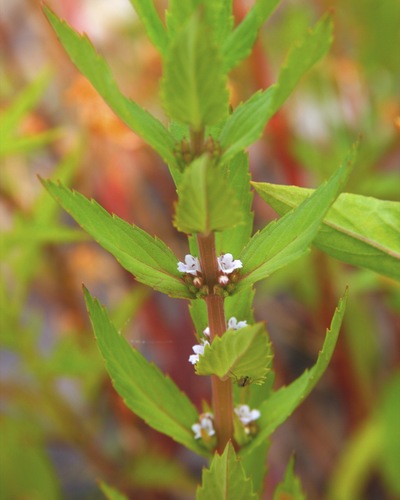
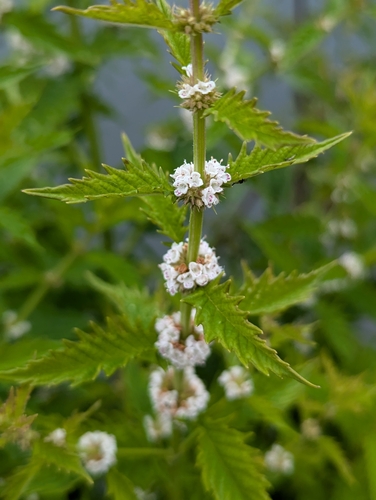
Gypsywort (Lycopus europaeus L.) is a somewhat straggling perennial plant with slender underground runners, reaching a height of roughly 20 to 80 cm (8 to 31 inches). Its leaves are arranged in opposite pairs, and are either stalkless or have short stalks. The leaf blades are hairy, narrowly lanceolate to ovate in shape, sometimes pinnately lobed, and have large teeth along their margins. Its inflorescence is a terminal spike made up of dense whorls of white or pale pink flowers. Each flower has a five-lobed calyx, and a two-lipped corolla around 4 mm (0.16 inches) long formed as a fused tube. The upper lip of each flower is slightly convex with a notched tip, while the lower lip has three lobes: the central lobe is the largest, and it bears a red "nectar mark" to attract pollinating insects. Each flower has two stamens, and the gynoecium is made of two fused carpels. The fruit is a four-chambered schizocarp. Gypsywort flowers are visited by many types of insects, so the species has a generalized pollination syndrome. Gypsywort grows mainly in wetland habitats, including along the edges of lakes, ponds, and streams, as well as in canals and marshes. Its carpels can float, which likely helps the plant disperse, and its rhizomatous roots also allow the plant to spread. It flowers from June to September, and produces seeds from August to October.