About Lycoperdon marginatum Vittad.
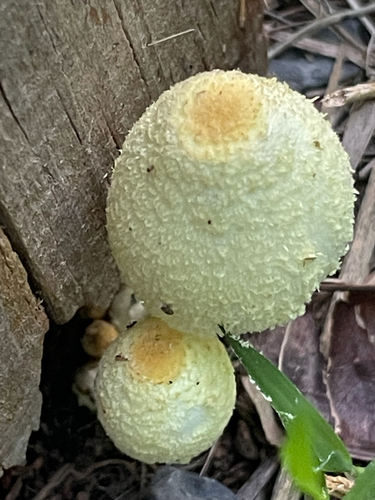
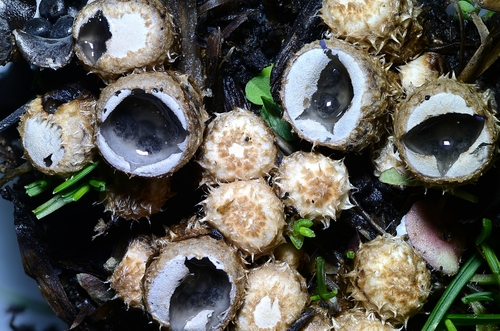
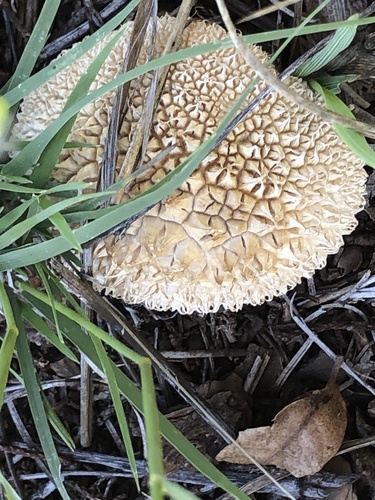
Lycoperdon marginatum Vittad. produces roughly spherical fruit bodies when young, which become flattened and more pear-shaped as they mature. Fruit bodies measure 1–5 cm (0.4–2.0 in) wide, and are held by a short, tapering stalk. When young, the fungus is initially white, and the surface of its peridium (spore case) is densely covered in short spines. Over time, these spines fall off in irregular sheets, revealing a smooth, brown underlying surface. Mature fruit bodies develop a small opening at the top to release spores. The internal spore-bearing tissue, called the gleba, is initially white and firm, but turns greenish-brown, then greyish-brown and powdery as the mushroom matures. The spores are spherical, covered in tiny warts, and measure 3.5–4.5 μm. This species has yellowish-brown capillitium threads that are 6–7 μm wide, with a few pores or septa. Lycoperdon echinatum is similar in appearance, but its spines do not break off in sheets. The exoperidium of Lycoperdon rimulatum sometimes peels off in sheets, but this species has no spines on its surface.
This puffball is a saprobic species. It grows on the ground either alone, scattered, or in groups. A fairly common species, it is often found growing on sandy soil, in nutrient-poor locations, or in oak-pine woods, and fruits between June and December. It has been recorded in Australia, Europe, and North and South America.
There are conflicting reports about the edibility of Lycoperdon marginatum. Some sources note that it is safe to eat when young, though it is insubstantial, while others describe it as poisonous. In Mexico, the species is used to produce auditory hallucinations, though chemical analysis of its fruit bodies has not found any substances that would cause this effect.