About Lycodon striatus (Shaw, 1802)
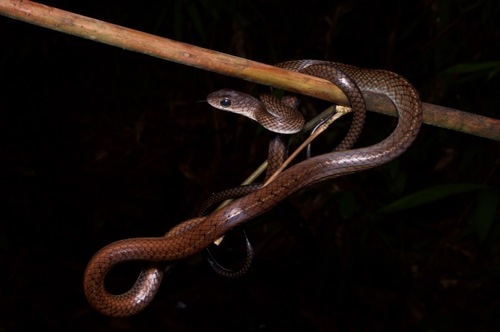
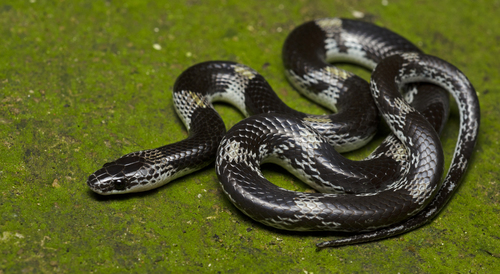
Lycodon striatus (Shaw, 1802) has a dark brown or black dorsal coloration, with widely spaced white transverse spots or crossbands on its anterior body. Its sides are lined with fine white lines, and a black marking sits opposite each white crossband. When preserved in alcohol, the upper lip and ventral surface are solid, uniform white. According to George Albert Boulenger’s 1893 records, the longest known adult of this species reached a total length of 43 centimetres (17 in), with a tail that measured 7.5 cm (3.0 in) long. Its head is only slightly distinct from its neck, and its snout is flattened. It has 8 upper labial scales, with the first and second upper labials making contact with the nasal scale. This species occurs in Afghanistan, India (specifically in Andhra Pradesh, Tamil Nadu, Gujarat, Karnataka, Madhya Pradesh, Maharashtra, Punjab, and Uttar Pradesh), eastern and north-eastern Iran, Nepal, Pakistan, Sri Lanka, western Tajikistan, southern Turkmenistan (Kopet Dagh), and Uzbekistan. Lycodon striatus favors dry habitats including semideserts and forest edges. Members of this species are nocturnal: during the day they shelter under stones, and emerge to hunt after dark. Their diet consists of skinks, geckos, and other small lizards. In India, adult females lay eggs in April. Clutch size is small, ranging from only 2 to 4 eggs. The eggs are relatively large, measuring 25–30 millimetres (1.0–1.2 in) long by 9–12 mm (0.35–0.47 in) wide. Parental care for the eggs of this species has been observed.