About Lycodon fasciolatus Shaw, 1802,2021
Scientific name: Lycodon fasciolatus Shaw, 1802 (2021)
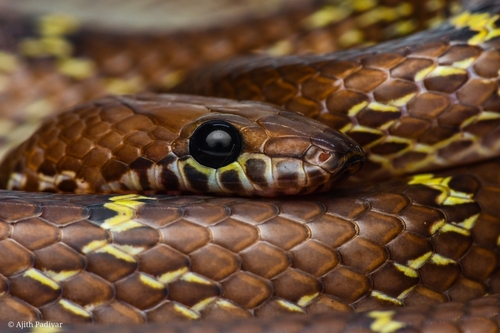
Morphological description: The snout is obtuse, curved, and prominent. The rostral scale is large, broader than it is wide; the portion of the rostral visible from above measures more than half the length of its distance from the frontal. The suture between the internasals is as long as the suture between the prefrontals, or slightly shorter. The frontal is nearly as long as its distance from the end of the snout, or nearly as long as the parietals. The loreal scale is as long as it is deep, or longer than deep. There is one pre-ocular, usually with a small subocular below it; there are two or three postoculars. Temporal scales follow the arrangement 2+2 or 2+3. There are 8 upper labials, with the fourth and fifth entering the eye orbit. 4 or 5 lower labials are in contact with the anterior chin-shields. The posterior chin-shields are nearly as long as the anterior, and are separated from each other by two or three series of scales. Dorsal scales are smooth, arranged in 21 or 23 rows. Ventral scales number 197–225; the anal scale is divided; subcaudal scales number 73–88.
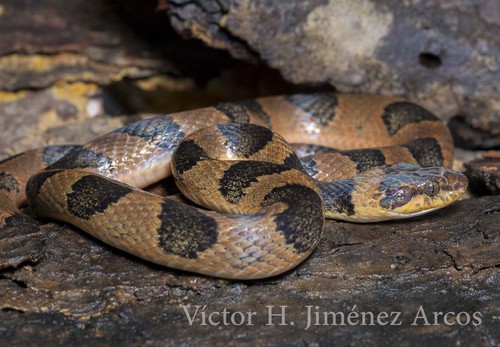
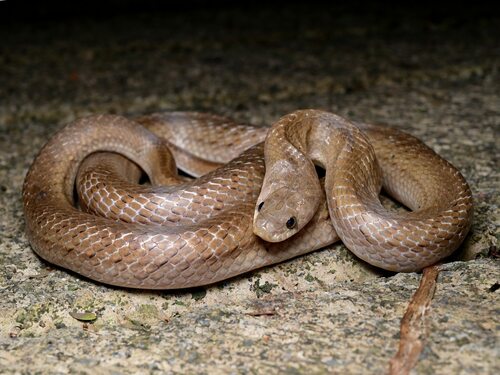
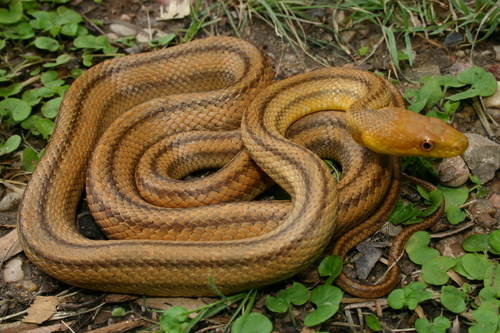
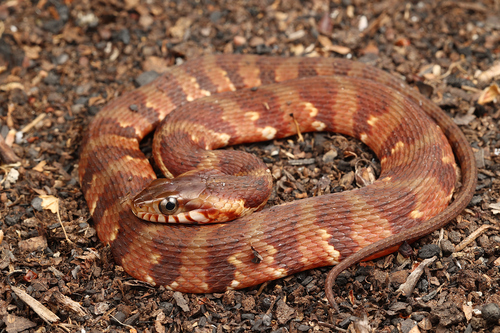
Dorsal coloration is yellowish or brownish olive, with narrow, variegated cross bands of white, brown, and black on the anterior half of the body. These bands may disappear entirely in adult individuals. The ventral surface is uniform yellowish. Maximum total body length is 1060 mm (3.5 feet), with a tail length of 220 mm (8.5 inches). Shaw's original species description was based on a plate from Russell's Ind. Serp. published in 1796.
Geographic range: This species is found in India (excluding North Bengal, Tamil Nadu, and Kashmir), as well as in Sri Lanka, Pakistan, Nepal, and Bangladesh.