About Lycodon aulicus (Linnaeus, 1758)
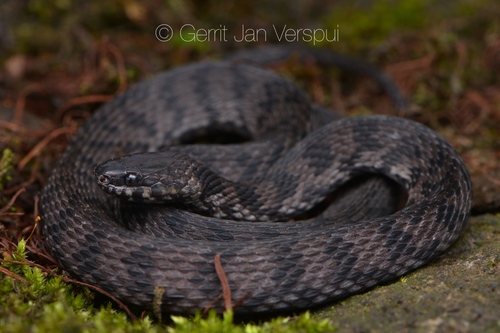
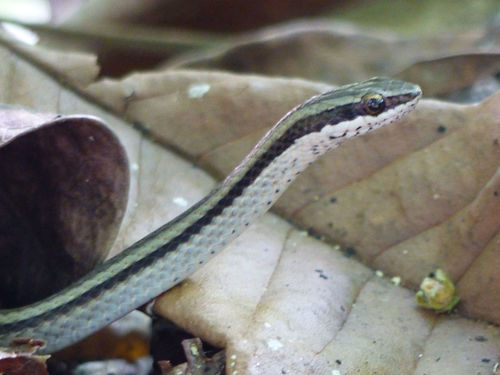
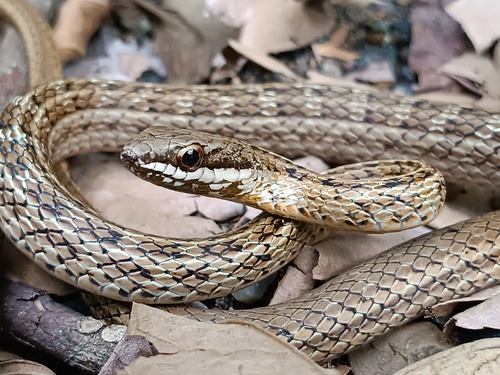
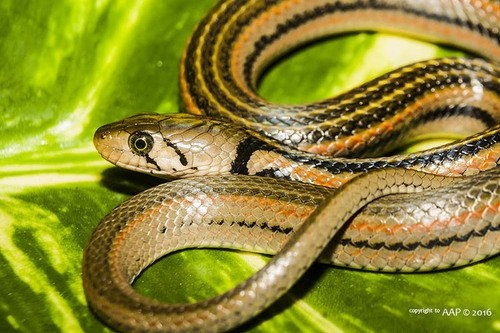
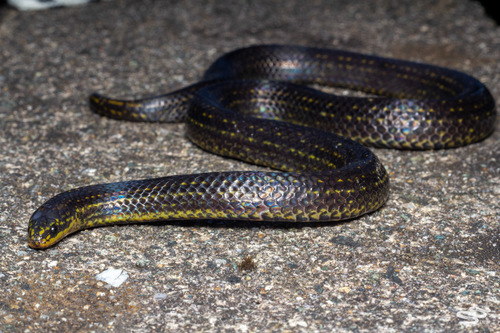
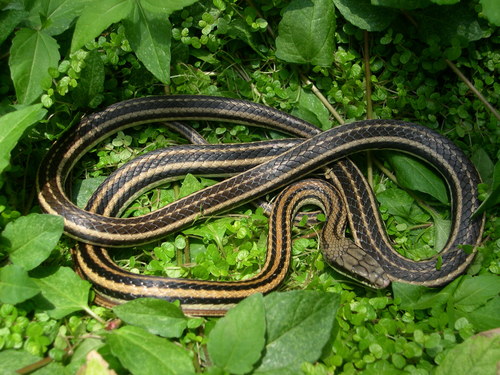
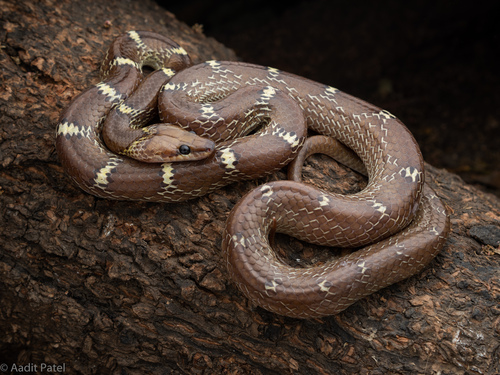
Lycodon aulicus (Linnaeus, 1758) is a snake species with highly variable coloration, and it is frequently confused with the common krait. The presence of a loreal shield can be used to distinguish this snake from kraits. Below is a detailed morphological description drawn from two major historical sources: Albert Günther's 1864 Reptiles of British India, and George Albert Boulenger's 1890 Fauna of British India, Reptilia and Batrachia volume. From Günther's 1864 description, the snout is broad, strongly depressed, long and spatulate, with a swollen upper lip and no canthus rostralis. The rostral shield is very low and broad, slightly curved backward onto the upper surface of the snout. Anterior frontals (called internasals in modern terminology) are very small; posterior frontals (prefrontals in modern terminology) are longer than they are broad, a trait that is much more pronounced in adult specimens than in juveniles. A lateral notch sits between the anterior and posterior frontals, which holds the inner anterior angle of the loreal. The posterior frontals have an obtuse lateral angle that aligns with the suture between the loreal and praeocular. The occipitals are elongate. The small nostril is directed upward, located between two nasals; the anterior nasal sits on the foremost portion of the snout. There is a single, large loreal that is nearly twice as long as it is broad. There is one praeocular that contacts the vertical (called the frontal in modern terminology) and the third labial; specimens where the praeocular does not reach the frontal are very rare. There are two postoculars, and the supraciliary is rather small. There are nine upper labials, and the third, fourth, and fifth labials extend into the orbit. Temporals are numerous and scale-like. Scales are smooth, with a tiny apical groove, and arranged in 17 rows. A distinct angular ridge runs along each side of the abdomen and tail. Ventral scales number from 183 to 209. The anal scale is bifid in most specimens, and entire only in a small number of individuals. Subcaudal scales number from 57 to 77. Each maxilla has two fangs at the front, arranged in a transverse line, with the outer fang much larger than the inner one. A lateral longitudinal series of small teeth begins some distance behind the fangs; these teeth number from four to twelve, and the last tooth in the series is considerably larger than the rest. Pterygoido-palatine teeth are small and all of equal size. Each side of the mandible has two or three fangs, followed by a series of small teeth. Günther organized the species' variable forms into two main groups based on morphology and geography: continental varieties and Ceylonese varieties. For continental varieties, posterior frontals are moderately elongated, and in young specimens they are nearly as broad as they are long. Each upper labial has a brown spot; specimens from the Philippine Islands are also included in this group. Four named continental varieties are recognized: Var. a is uniformly brown above with no collar, found in the Malayan peninsula, Bengal, and Madras. Var. b is uniformly brown above with a white collar, found in Madras. Var. c is brown or greyish brown, with faint traces of a white network pattern and a white collar that is more distinct in young specimens than in older ones, found on the Coast of Malabar, Pinang, the Malayan peninsula, Gamboja, the Philippine Islands, and Timor. Var. d is ferruginous or chestnut-brown, with white cross bars on the back edged in brown; the cross bars are sometimes split on the sides, with branches of one band connecting to branches of the preceding and following bands. The first cross bar forms a collar, and bands on the rear of the body gradually become indistinct. This is a very common variety; it is similar to the snake figured by Russell (volume i, plate 16) but is specifically distinct. It has been recorded from Pinang, Bengal, Nepal, Kangra (Himalayas), the Dekkan, and the Anamallay Mountains. For Ceylonese varieties, posterior frontals are much more elongated, and are much longer than broad at all ages. Upper labials are white or shaded with brown, with three named varieties: Var. e is uniformly brownish grey above. Var. f is brown, with three or four broad, widely spaced white cross bands on the anterior half of the body; the anterior band forms a collar, and the other bands are broadest along the sides. Var. g is brown or greyish, with pure white or reticulated white cross bands that extend downward to the belly, where they are widest. From Boulenger's 1890 description, the snout is much depressed, with swollen lips, and is spatulate in adult individuals; the eye is rather small. The rostral is much broader than it is long, and is just visible when viewed from above. Internasals are much shorter than the prefrontals. The frontal is usually shorter than the distance from its anterior edge to the tip of the snout, and shorter than the parietals. The loreal is elongated and does not extend into the eye. There is one praeocular, which usually contacts the frontal. There are two postoculars. Temporals are small and scale-like, arranged in 2+3 or 3+3 pattern. There are 9 upper labials, with the third, fourth, and fifth entering the orbit. Four or five lower labials contact the anterior chin-shields, and the anterior chin-shields are longer than the posterior ones. Scales are smooth and arranged in 17 rows. Ventral scales number 183-209 and are obtusely angled along the sides. The anal scale is divided. Subcaudal scales number 57-77 and arranged in two rows. Coloration is variable: dorsal surfaces can be uniformly brown, marked with white transverse bands, or marked with white reticulation. The upper lip can be uniformly white, or marked with brown spots. Ventral surfaces are uniformly white. The total adult length is 71 cm (28 in), with the tail measuring 11 cm (4.3 in). The known distribution of Lycodon aulicus includes Pakistan, Sri Lanka, India (extending north to the Himalayas and Assam, and present in Maharashtra and Gujarat), Bangladesh, Nepal, and Myanmar (also called Burma). Historical records also note its presence in the Himalayas, Ceylon (now Sri Lanka), India, Burma, Siam, the Malay Peninsula, Java, the Philippines, and Timor. It is one of the most common snake species in India and Sri Lanka, but becomes less common along the coasts of southeastern India. In terms of reproduction, females are often larger than males. Breeding occurs before the monsoons, and females lay 5 to 7 eggs per clutch. Eggs hatch in September or October, and newly hatched hatchlings measure 14–19 cm (5.5–7.5 in) long.