About Lycium ruthenicum Murray
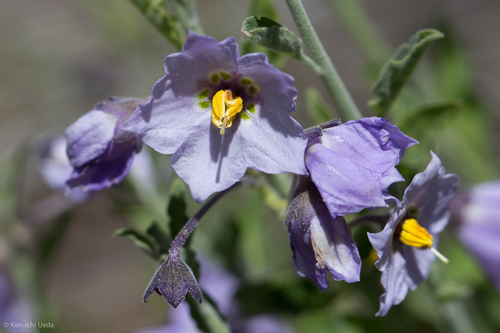
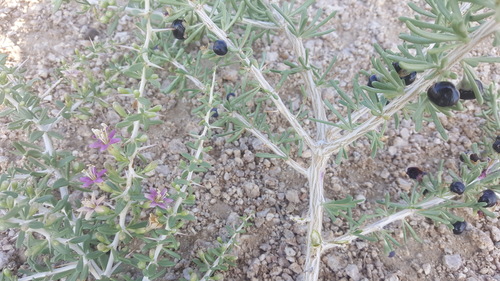
Lycium ruthenicum Murray is a shrub that ranges in height from 20 to 180 centimetres (7.9 to 71 inches). Its leaves measure between 5 to 30 millimetres (0.20 to 1.18 inches) in length, and 1 to 1.5 millimetres (0.039 to 0.059 inches) in width, matching a commonly cited range of 0.6 to 2.5 centimetres (0.24 to 0.98 inches) for length. Each flower has 2 to 4 bell-shaped sepals that are 3 to 4 millimetres (0.12 to 0.16 inches) long. Its pedicels are either 5 to 10 millimetres (0.20 to 0.39 inches) long, or about as long as the sepals. The calyx is typically 2.5 to 3.5 millimetres (0.098 to 0.138 inches) long, but bell-shaped (campanulate) calyxes can reach 4 to 5 millimetres (0.16 to 0.20 inches) in length. The corolla tube is 5 to 7 millimetres (0.20 to 0.28 inches) long. Its berries, which are borne on stamens that measure 5 to 8 millimetres (0.20 to 0.31 inches) long, are broad and globose, and can occasionally grow up to 9 millimetres (0.35 inches) long. The seeds inside the fruit are brown and 1.5 to 2 millimetres (0.059 to 0.079 inches) long. This species usually flowers from June to August, and sometimes also blooms in May. Its fruits mature from August to October. This plant grows in Nubra Valley, India, where local people use it to cure blindness in camels. It also grows in Central Asia and Northwest China, found at elevations between 400 and 3,000 metres (1,300 and 9,800 feet) in saline deserts, sandy areas, and alongside roads.