About Lycium pallidum Miers
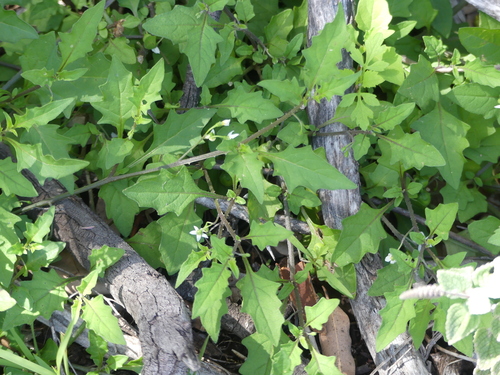
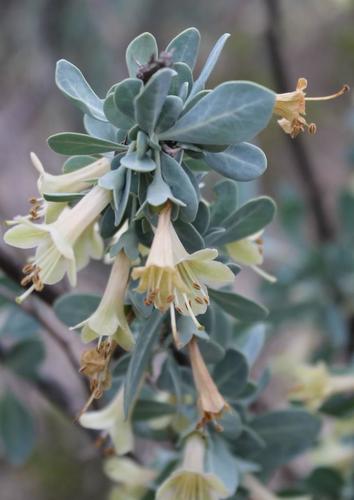
This species is a shrub, formally named Lycium pallidum Miers. It reaches 1 to 3 meters (3 feet 3 inches to 9 feet 10 inches) in height, and grows as a dense tangle of spiny spreading or erect branches, often forming bushy thickets. Its pale leaves give the plant its specific name pallidum. Flowers grow solitary or in pairs, are funnel-shaped, and range in color from creamy-yellow to yellowish-green, or greenish cream that is sometimes tinged with purple. The flowers are fragrant and pollinated by insects. The fruit is a juicy, oval-shaped, shiny red berry that holds up to 50 seeds. The plant reproduces by seed, and can also spread via cuttings, suckering, and layering. It grows in many types of desert habitat, and also occurs in pinyon-juniper woodland, sagebrush, shrubsteppe, savanna, and other ecosystems. It tolerates high-salinity soils. It is a characteristic component of Mojave Desert flora, and can also be found in the Sonoran and Chihuahuan Deserts. In the Mojave Desert, it grows alongside winterfat (Krascheninnikovia lanata), Pima rhatany (Krameria erecta), spiny hopsage (Grayia spinosa), Shockley goldenhead (Acamptopappus shockleyi), Frémont's dalea (Psorothamnus fremontii), spiny menodora (Menodora spinescens), and species of ephedra, prickly pear, and yucca. In Arizona, it grows in riparian habitat alongside sycamore (Platanus wrightii), willows (Salix spp.), Arizona walnut (Juglans major), Fremont cottonwood (Populus fremontii), alligator juniper (Juniperus deppeana), Arizona white oak (Quercus arizonica), and velvet ash (Fraxinus velutina). This plant is commonly found around Anasazi ruins; this may be because Anasazi people simply collected the plant and dropped its seeds, but it is also possible that they cultivated it. Many types of animals eat its fruits; phainopeplas especially favor the fruit, and woodrats feed on the foliage. Native Americans used this plant for multiple medicinal and non-medicinal purposes. The Navajo used it to treat toothache, considered it a sacred plant, and sacrificed it to the gods. Several Native American groups used the fruit as food, consuming it fresh, cooked, or dried, eating it mixed with clay, boiling it into a syrup, or processing it into beverages. Among the Zuni people, berries are eaten raw when fully ripe, or boiled and sometimes sweetened. Ground leaves, twigs, and flowers were given to warriors to provide protection during war.