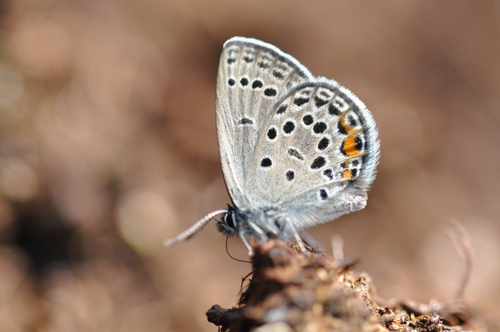
About Lycaenidae
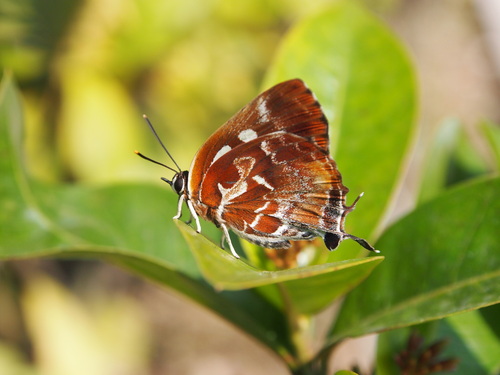
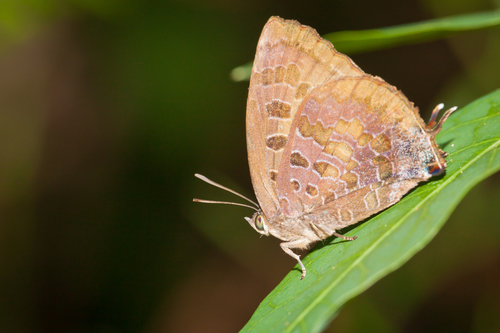
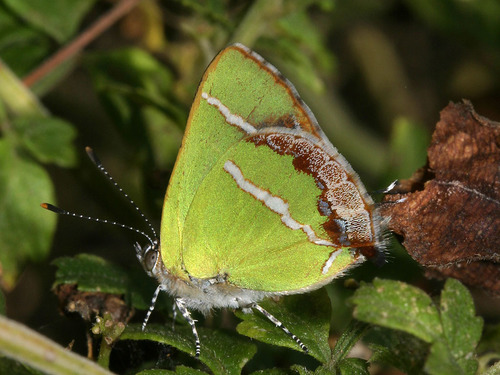
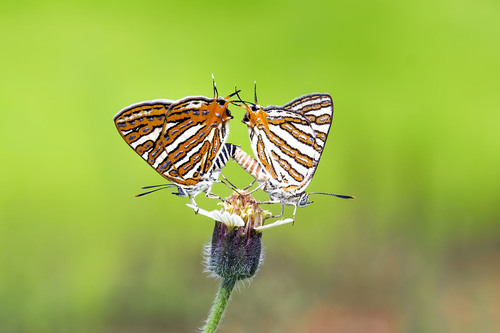
Lycaenidae is a family of butterflies whose adult members are small, usually measuring under 5 cm (2 in). They are brightly colored, often with a metallic gloss, and their wings are generally blue or green. Over half of all Lycaenidae butterflies rely on ants in some form of interaction, and around 75% of all species associate with ants in a relationship called myrmecophily. These associations can be mutualistic, parasitic, or predatory depending on the specific species. Lycaenidae larvae are typically flattened rather than cylindrical, with thickened cuticles and glands that can produce secretions to attract and subdue ants. Some larvae can create vibrations and low sounds that travel through the surfaces they live on, which they use to communicate with ants. Adult Lycaenidae often have hairy antenna-like tails with a black and white ringed (annulated) appearance. Many species also have a spot at the base of the tail, and some turn around after landing to confuse predators about the actual location of their head. This behavior either lets the butterfly detect an approaching predator early when it approaches the true head, or leads the predator to attack the false head, leaving the predator with only a mouthful of dusty wing scales. Lycaenid caterpillars have very diverse feeding habits. Most eat plant matter, but some are entomophagous, feeding on aphids, scale insects, and ant larvae. Some Lycaenidae even exploit their ant association by inducing ants to feed them via regurgitation, a process called trophallaxis. In mutualistic relationships, ant workers attend and protect Lycaenidae larvae while the larvae feed on host plants, and the ants receive sugar-rich honeydew from the larvae for the full larval lifespan, and sometimes through the pupal stage. In other species, only the first few larval instars develop on plants; the rest of the larval stage is spent as a predator inside ant nests, where the caterpillar acts as a parasite feeding on ant regurgitation, or as a predator that eats ant larvae. In these cases, caterpillars pupate inside the ant nest, and ants continue to care for the pupae. Just before adult emergence, the developing butterfly's wings detach from the inner pupal case, and the pupa turns silvery. The adult butterfly emerges from the pupa after three to four weeks, while still inside the ant nest, and must crawl out of the nest before it can expand its wings fully. Multiple evolutionary adaptations support these ant associations. These include small glands on caterpillar skin called pore cupola organs. Many species have a honeydew-producing gland on the seventh abdominal segment called the dorsal nectary gland, also known as Newcomer's gland. An eversible, cylindrical organ called the tentacular organ sits on the eighth abdominal segment, topped with a ring of spikes; it emits chemical signals thought to help the caterpillar communicate with ants.