About Lycaena phlaeas (Linnaeus, 1761)
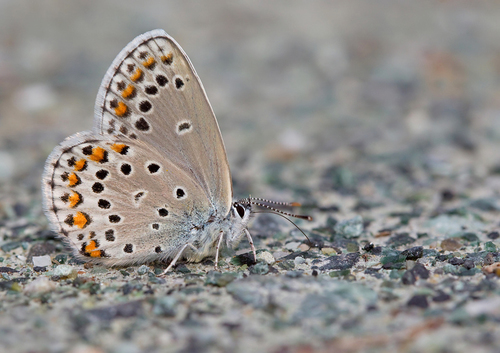
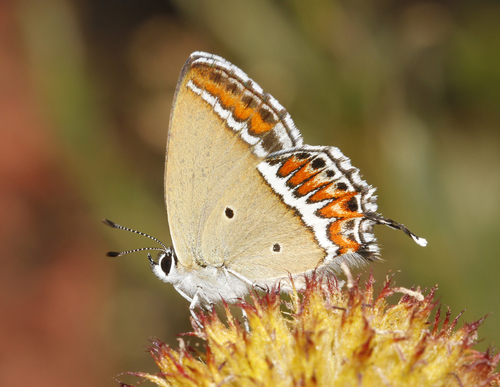
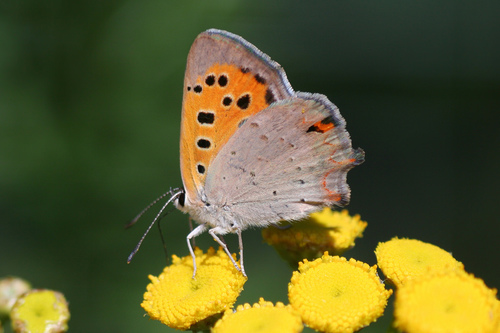
This species has the scientific name Lycaena phlaeas (Linnaeus, 1761). On the upper side of its wings, the forewings are bright orange with a dark border along the outer edge and eight or nine black spots. The hindwings are dark with an orange border. Some female individuals have a row of blue spots inside this orange border, and this variant is classified as form caeruleopunctata. The underside of the wings follows a similar pattern to the upperside, but is paler overall. The black spots on the underside of the forewings are outlined in yellow, and the dark colouring seen on the upper side is replaced by a pale brownish grey. The underside of the hindwings matches this brownish grey colour, has small black dots, and is edged by a narrow orange border. The caterpillar larvae are usually green, though some individuals have a purple stripe running down the middle of the back and along each side. Lycaena phlaeas is a holarctic species that is widespread and common across Europe, Asia, and North America. It is also found in North Africa, ranging south as far as Ethiopia. In the United Kingdom, it occurs almost anywhere across southern and central England and Wales, though it never appears in large numbers. Its distribution becomes more patchy in northern England, Scotland, and Ireland. This butterfly can be found in a very wide range of habitats, including chalk downlands, heathland, woodland clearings, churchyards, and waste ground in cities. Females lay eggs singly and visibly on the upperside of food plant leaves. After hatching, young caterpillars feed on the underside of the leaf, creating transparent "windows" by leaving the upper leaf epidermis intact. Pupation happens in leaf litter, and it is thought that ants tend the pupa. Lycaena phlaeas produces between two and three broods per year, with fewer broods occurring at more northern latitudes. In exceptionally favourable years, a fourth brood may sometimes develop in southern regions, and adult butterflies can still be seen flying as late as November. This species overwinters in the caterpillar stage.