About Lycaena dispar (Haworth, 1803)
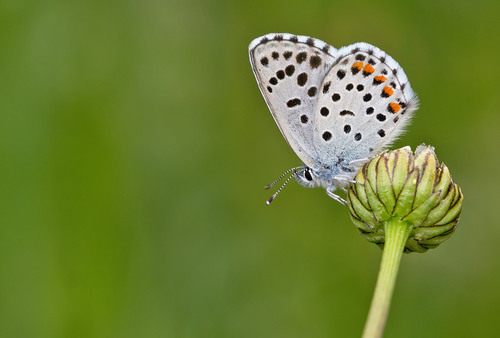
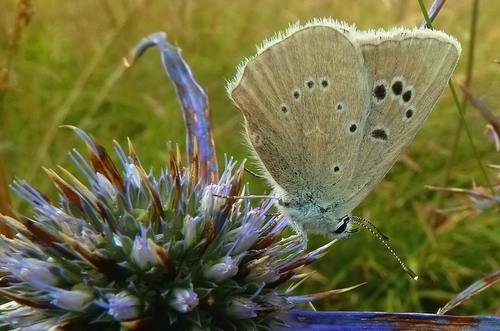
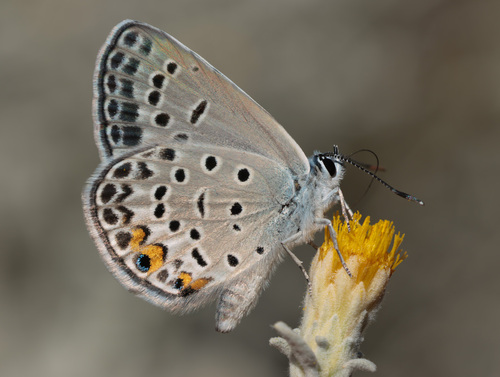
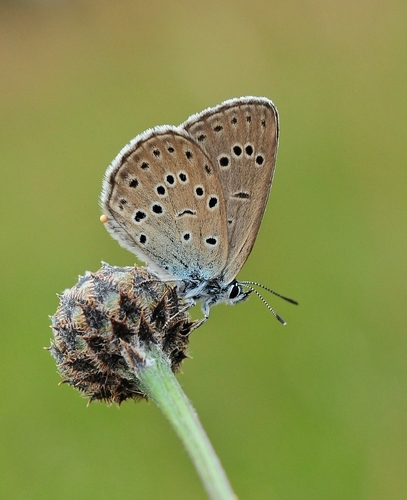
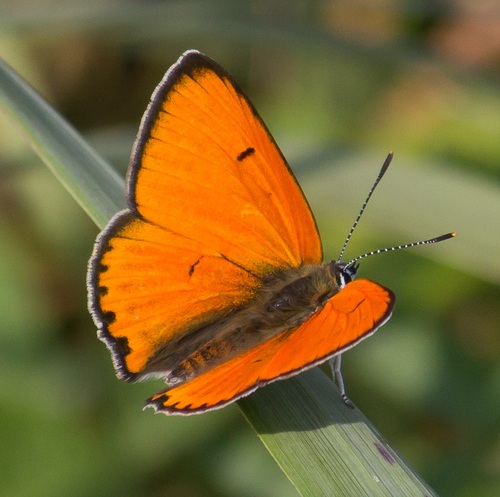
Lycaena dispar, commonly known as the large copper, is a large lycaenid butterfly with a wingspan ranging from 44 to 52 mm. This species displays strong sexual dimorphism. Males have bright orange wings that feature narrow black margins and white fringes. Short androconia, also called sex brands, are located near the leading edge of the forewing in males. Females have broader dark brown margins on their forewings, along with a parallel row of dark spots. Both sexes have a distinctive silvery-blue pattern on the underside of their hindwings, which is marked with black spots and an orange submarginal band. This unique silvery underside separates L. dispar from closely related species like Lycaena virgaureae and Lycaena hippothoe, species that live in drier environments. Subspecies of L. dispar can be told apart by their size, the extent of their black markings, and the length of the orange band on the underside of the hindwing. The now extinct English subspecies L. d. dispar was noticeably variable in size, and had larger spots on its wing undersides than subspecies found in continental Europe. Lycaena dispar occurs across Eurasia between 40° and 60° latitude. Currently, the species can be found in Armenia, Austria, Azerbaijan, Belarus, Belgium, Bulgaria, China, Croatia, Czech Republic, Estonia, Finland, France, Georgia, Germany, Greece, Hungary, Italy, Kazakhstan, Republic of Korea, Latvia, Lithuania, Luxembourg, Moldova, Mongolia, Montenegro, Netherlands, Poland, Russian Federation, Serbia, Slovakia, Slovenia, Switzerland, Türkiye, Ukraine and Uzbekistan. Population trends for this species vary sharply across its range: it has experienced severe decline in north-western Europe, remains stable or is expanding in central and northern Europe, and has a mixed conservation status across Asia. Lycaena dispar is primarily a wetland species, though its specific habitat preferences differ by geographic location. It favors undisturbed grasslands along riverbanks and stream banks, particularly areas that support its larval food plants. To prevent mortality from flooding, L. dispar often uses plants growing away from water edges, within reed-fen vegetation. The butterfly prefers warmer microclimates, as these allow for faster larval development. Agricultural disturbance, especially mowing that occurs shortly after egg-laying, causes extreme population loss by destroying eggs and removing food sources for hatching larvae. Most populations of L. dispar in Europe are bivoltine, meaning they produce two generations per year: the first emerges between May and June, and the second in late July to early September, with peak adult flight activity occurring in July. Northern populations such as those in Estonia are univoltine, producing only one generation per year, while southern populations may occasionally produce a partial third generation. The species overwinters as half-grown third-instar larvae, which enter diapause in response to temperatures below 15°C and changes in photoperiod. Larvae resume feeding in early May once temperatures rise above 25°C. High mortality occurs during the overwintering period, especially when flooding is prolonged. Female L. dispar lay approximately 32 eggs per batch, and can produce around 714 eggs over their lifetime. Females lay eggs on sunny host plants located in optimal microclimates. Existing herbivore damage or fungal infections on host plants do not have a significant impact on female oviposition choices. When larvae reach maturity in late June, they migrate up to 25 cm away from their host plant, and pupate roughly 10 cm above ground level. During this migration, larvae change color from bright green to pale yellow-brown as camouflage. Pupation lasts between 10 and 14 days.