About Lycaena alciphron (von Rottemburg, 1775)
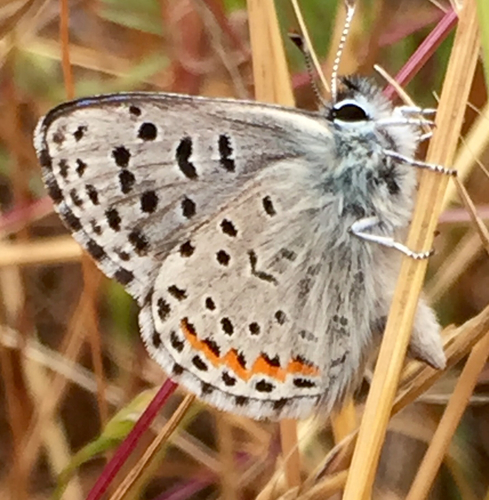
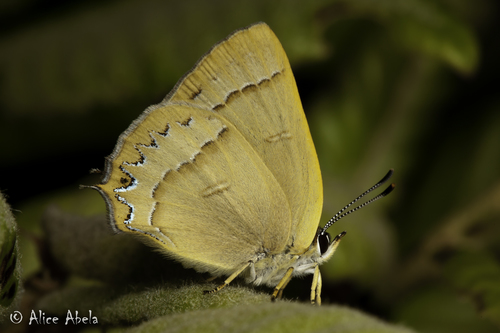
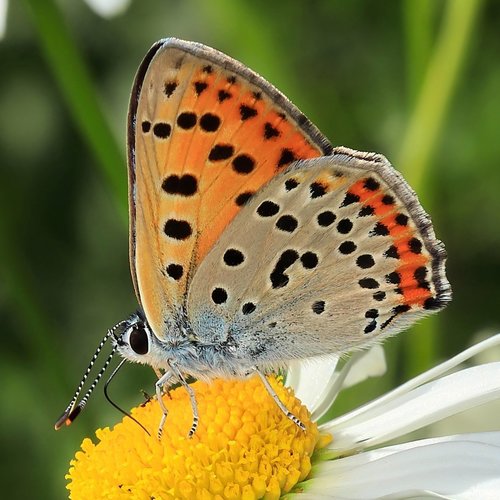
This butterfly species, Lycaena alciphron (von Rottemburg, 1775), has multiple synonyms: C. alciphron Rott. (= lampetie Schiff., virgaureae Hufn., hiere F., helle Bkh., hipponoe Esp.). The name-typical form is lighter yellow and less golden than Lycaena hippothoe. The upperside of male name-typical individuals is distinct from all other Chrysophanus: it is so heavily dusted with dark bluish-glossed scales that its yellow ground-colour is nearly obscured. This dark scaling is only interrupted by black discal spots and a reddish yellow distal band on the hindwing. The underside has a fairly uniform colour, with a brighter reddish yellow tone on the forewing disc, and numerous rather large round ocelli with strong whitish edging. The base range of the species extends through Central Europe and southern districts of North Europe, from the shores of the North Sea and Baltic provinces to the Alps, and from northern France to the Altai and Mongolia. The southern population of the species is represented by the much larger subspecies gordius Sulz. Both sexes of gordius are bright yellow-red on the upperside, with very prominent heavy black spots on the upperside, and a yellow rather than blue-grey hindwing underside. Nearly all intermediate forms exist between gordius and the name-typical form. One such intermediate is meliboeus Stgr. Males of this form are larger than name-typical alciphron but smaller than most gordius, with yellowish red ground-colour breaking through the dark scaling, though the colour is less pure than in true gordius. This form occurs in Greece, Asia Minor and northern Persia. Greek specimens differ slightly from those from Anterior Asia, but the differences are not large enough to warrant a separate name. Another form, granadensis Ribbe, reaches at most the size of name-typical alciphron, and is often even smaller. It matches gordius in its bright yellowish red upperside colour, but has larger upperside spots even than gordius, and occurs in Spain. Aberrant transitional specimens from gordius to the name-typical form have been described by Steffanelli as ab. intermedia, collected from Boscolungo in Italy; in this form, the female hindwing is dark except for a yellowish red submarginal band. Black spot size and patterning varies in the species, similar to other preceding Chrysophanus species. In ab. subfasciata Schultz, all upperside spots are so large that the submarginal row of spots is united into a band that is barely interrupted by veins. In ab. mutilata Schultz, the ocelli located in the cells on the underside are strongly developed, while nearly all distal ocelli are absent. An aberrant gordius form with similarly reduced underside ocelli is named ab. evanescens Gillm. In ab. viduata Schultz, an alciphron aberration, underside ocelli are so weakly visible on the upperside that the upperside appears almost without spots. ab. infulvata Schultz is the name for females that are entirely uniformly black-brown on the upperside, even lacking the reddish yellow submarginal band on the hindwing, and corresponds to ab. nigra of hippothoe. The trait of ocelli modified into streaks, often observed in hippothoe, is considerably rarer in alciphron according to Schultz; Schultz names such specimens ab. constricta. Like most Chrysophanus eggs, the egg of this species is flattened, green-yellow, and has a reticulate surface. The larval stage lasts from August to early May. Larvae are green and almost unicolorous, with a whitish green longitudinal stripe along the back and another on each side, shaded with dark. The head, only visible when the larva is feeding, is black-brown, and larvae feed on Rumex. The pupa is fastened near the ground with very thin threads, and is olive-green with darker shadowy stripes. Adult butterflies are on the wing in June and July. They are less restricted to specific, limited flight sites than the preceding species L. hippothoe, but occur much more singly and prefer drier localities. Adults frequently visit flowers, especially bramble flowers at sunny waysides. According to Courvoisier, gordius specifically favours clusters of thyme and Sedum album, and ascends in the Alps up to 10,000 feet.