About Luzuriaga radicans Ruiz & Pav.
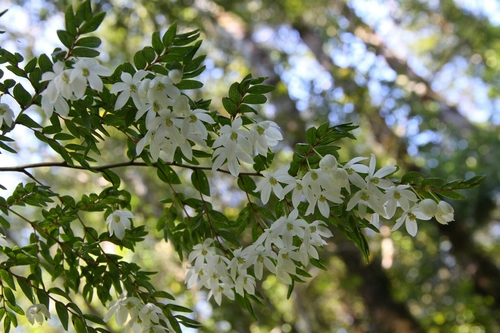
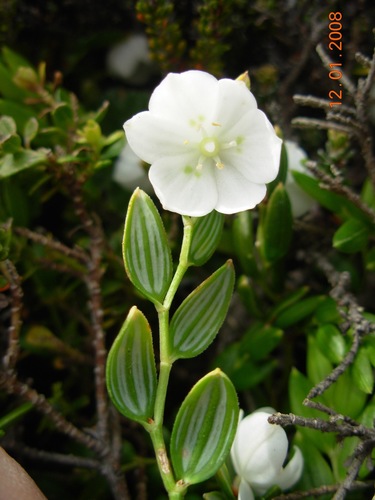
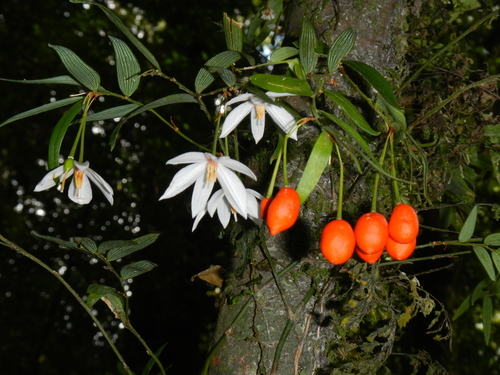
Luzuriaga radicans Ruiz & Pav. is an evergreen climbing plant, with fine roots that adhere to tree trunks. Its leaves are alternate, positioned toward the ends of stems, have entire margins, and are oblong-lanceolate in shape, ending in an abruptly pointed acute tip. The leaves are light green, measure 1–4 cm long and 0.3–1 cm wide, and bear 9–13 white lines on their undersurface. The flowers are hermaphroditic, 1 cm long, and grow either singly or in inflorescences holding 2–4 flowers. Its six white tepals are uneven in size. There are six stamens, and the style, which is longer than the stamens, ends in a three-lobed stigma. The fruit is a smooth, globose red-orange berry 0.8–1 cm in diameter, containing up to twelve flattened seeds that are around 4 mm long. This species is native to South Central to southern Chile and southern Argentina. In Chile, it grows from Colchagua to Aisén provinces, which correspond to regions VI–XI. It prefers shady, humid habitats with constant rainfall under dense vegetation cover. In coastal areas it grows up to 500 m in elevation, while in coastal mountain areas it occurs between 500 and 2000 m. It also grows at low altitudes in interior valleys. Luzuriaga radicans thrives in humid environments and can grow either partially or fully in water, including in marshes, bogs, and on the shores of lakes and rivers. Cultivation of this plant is difficult. After the vine is removed from a host tree, it takes approximately 5 years to regrow. The plant is valued as an ornamental. Its stems are used to make household utensils and handicrafts, including basketry and brooms. Historically, stems were also used for fences and ropes, but today they are mainly used for artisanal crafts. The fruit is edible and eaten raw; it was once a traditional food, but it is no longer commonly used for this purpose.