About Luzula sylvatica (Huds.) Gaudin
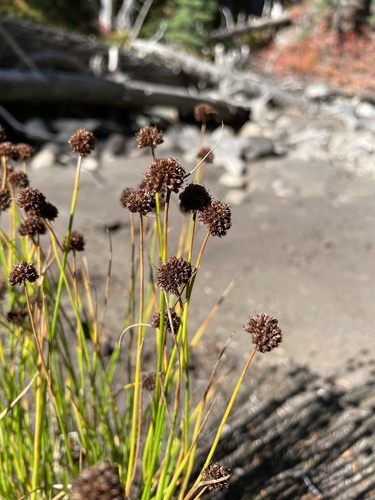
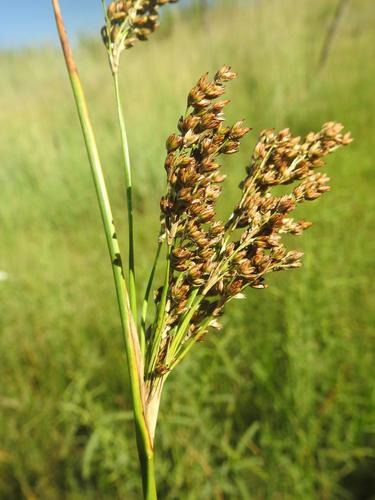
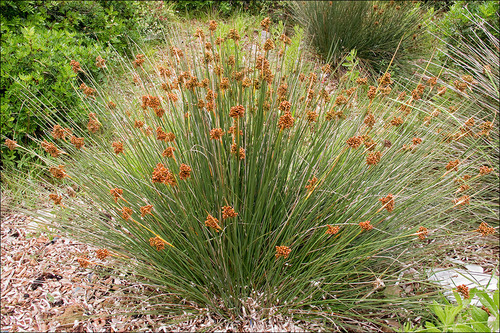
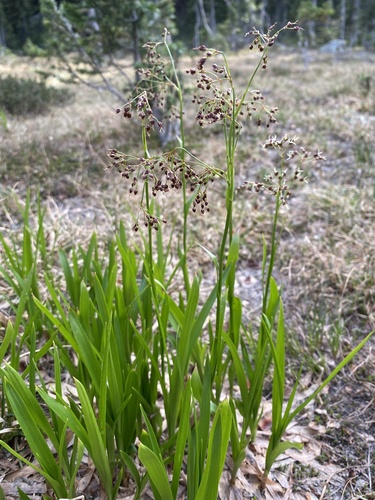
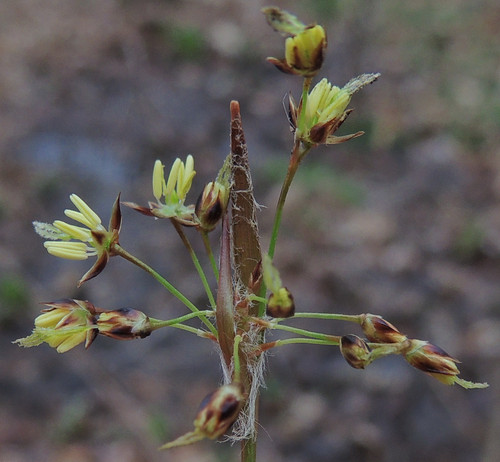
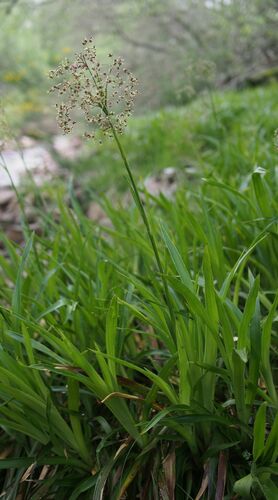
Luzula sylvatica (Huds.) Gaudin, the largest woodrush, has stems that reach 30–80 centimetres (12–31 in) in height. It grows in clumps of bright green, glossy, flat, linear leaves; these leaves measure around 10–30 centimetres (3.9–11.8 in) long and 1 centimetre (0.39 in) wide, and stay green or at least greenish through the entire winter. Scattered white hairs along the leaf edges help distinguish this plant from similar species in the closely related genus Juncus. Its tepals are 3–3.5 millimetres (0.12–0.14 in) long, and flowers grow in groups of 3 or 4. Flowering occurs from mid-spring to summer, and flowers are borne in open panicles. These very small, chestnut-brown flowers can form both dense and lax clusters. This species is sometimes stoloniferous, and can be pollinated by either wind or insects. The fruit of L. sylvatica is a 3-valved capsule that holds three oblong seeds. Each seed is indistinctly reticulate, and often bears a caruncle, which is a basal or apical appendage; seeds usually germinate close to their parent plant. Luzula sylvatica has a wide native distribution across Europe, where it is classified as a European temperate flora element, and southwest Asia, including the British Isles. In the British Isles, most populations are widespread and stable, though the species has experienced a decline in central and southeast England. There is a single recorded occurrence of this species in Washington state, United States. It typically grows in partial to full shade, and generally occurs on acidic soils in damp habitats. It can be found growing on stream banks, in well-drained open woodland, on open ground, on rock ledges, and in peaty heath moors. Although it prefers acidic soils, it can tolerate most soil pH levels. In ecology, golden eagles pick the winter leaves of Luzula sylvatica to line their eyries. The flowers and seeds of this species are the only food source for the larvae of the Coleophora sylvaticella moth. Luzula sylvatica is commonly used in horticulture. It is valued for its thick, patch-forming growth habit that suppresses weeds, its hardiness, and its ability to grow in shade and damp soils. It is widely used as ground cover and/or as an ornamental grass. The cultivar 'Marginata' has received the Royal Horticultural Society's Award of Garden Merit.