About Luzula acuminata Raf.
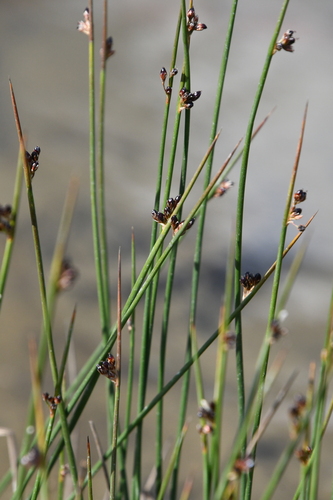
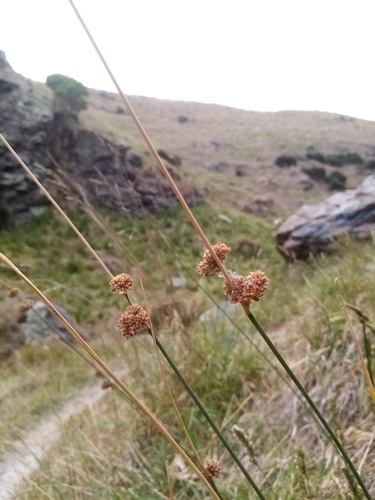
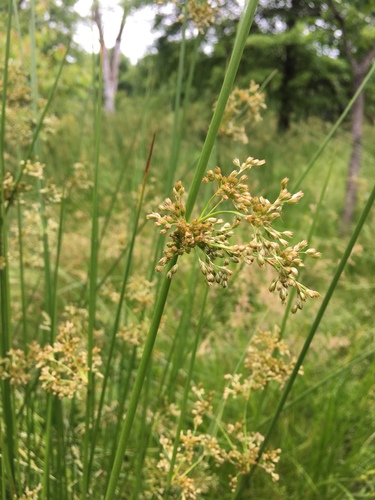
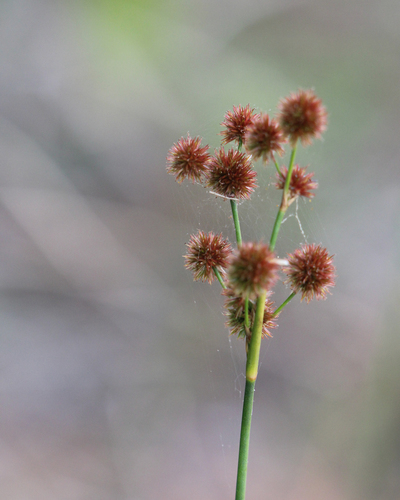
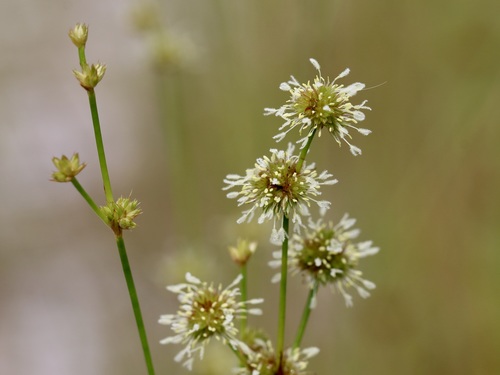
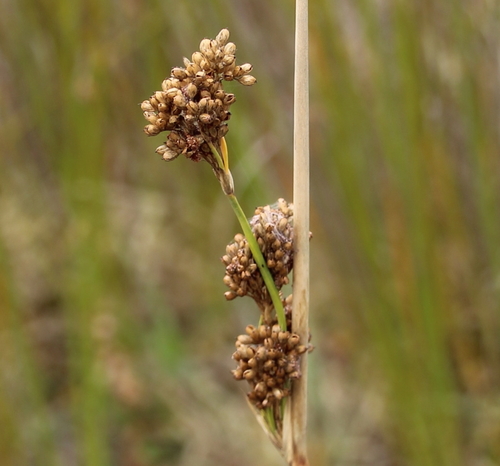
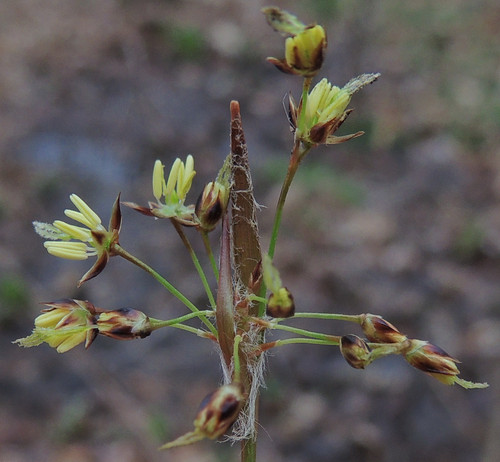
Luzula acuminata Raf. is a perennial grass-like plant. It flowers during May and June, growing between 4 inches and 16 inches tall. Its leaves are simple, with entire margins, linear in shape, and covered in fine, dense white hairs (tomentose pubescence). Leaves range from 2 to 12 inches long and up to ½ inch wide; they are brownish at the base, have pointed apexes, and parallel leaf veins. They typically turn reddish in the fall. This plant has solitary flowers with six petals. Individual plants bear between 5 and 20 slender flowers, each approximately ¼ inch wide. When the flower opens, its stalk varies in color from green to yellowish to dark brown. Fibrous roots grow along the plant's rhizome; fresh roots are bright white, while older roots turn yellow or brown. In May and June, this species produces seed capsules that drop seeds; each capsule holds three seeds. In the United States, Luzula acuminata is commonly found across many central and eastern states, ranging from Maine to Florida, and west to Wisconsin, South Dakota, and Louisiana. It grows as an understory plant in mesic to dry forests, and can be found in deciduous woodlands, mixed deciduous-evergreen woodlands, wooded bluffs, ravines, and forest clearings. It grows in USDA hardiness zones 3 through 8. It is closely associated with the varieties Luzula acuminata var. carolinae (Carolina Woodrush), Luzula luzuloides ssp. luzuloides (Oak-Forest Woodrush), Luzula echinata (Spreading Woodrush), Luzula bulbosa (Bulbous Woodrush), and Luzula multiflora var. multiflora (Common Woodrush). This species provides forage for deer and other small mammals. It is used in landscaping for its attractive appearance and ability to thrive in shaded areas. It is also used for soil erosion control, thanks to its dense, fibrous root system.