About Lutra lutra (Linnaeus, 1758)
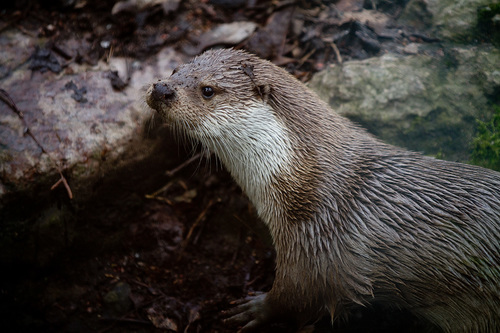
The Eurasian otter (Lutra lutra) is a typical member of the otter subfamily. These are long, slender animals that have brown fur on their backs and cream-coloured fur on their bellies, and are well adapted for an aquatic lifestyle. Their bones develop osteosclerosis, which increases bone density and reduces buoyancy to suit their water-based life. This species can be distinguished from the North American river otter by its shorter neck, broader face, greater distance between the ears, and longer tail. Because the Eurasian otter is the only otter species present across most of its range, it is rarely confused with other animals. Excluding the tail, adult Eurasian otters normally measure 57 to 95 cm (22.5 to 37.5 in) long; their tails add an extra 35–45 cm (14–17.5 in) in length. Females are shorter than males. The species has an average body weight of 7 to 12 kg (15 to 26 lb), though large older males can occasionally reach up to 17 kg (37 lb). The largest recorded specimen, reported by a reliable source but not formally verified, weighed more than 24 kg (53 lb).
The Eurasian otter is the most widely distributed otter species. Its range covers Europe, North Africa, and parts of Asia extending to the Palestine region. It is currently thought to be extinct in Liechtenstein and Switzerland. It is now common in Latvia, along the coast of Norway, in the western regions of Spain and Portugal, and across Great Britain and Ireland. In Italy, it only occurs in the southern part of the Italian peninsula. It inhabits unpolluted freshwater bodies including lakes, streams, rivers, canals, and ponds, as long as these areas have an adequate food supply. In Andalusia, it also uses artificial lakes located on golf courses. It prefers open sections of streams, and can also live along the coast in saltwater habitats, but it requires regular access to fresh water to keep its fur clean. In Syria, the Eurasian otter has been recorded in mountain creeks in Latakia and Raqqa Governorates, and in the lower Euphrates valley in Deir ez-Zor Governorate. In western Nepal, its presence has been documented at an elevation of around 1,600 m (5,200 ft) in the Barekot river, Jajarkot District, and at 1,337 m (4,386 ft) in the Tubang river, Eastern Rukum District. In India, it is distributed across the Himalayan foothills, southern Western Ghats, and the central Indian landscape.